
Machine Learning for Businesses: Trends in 2027

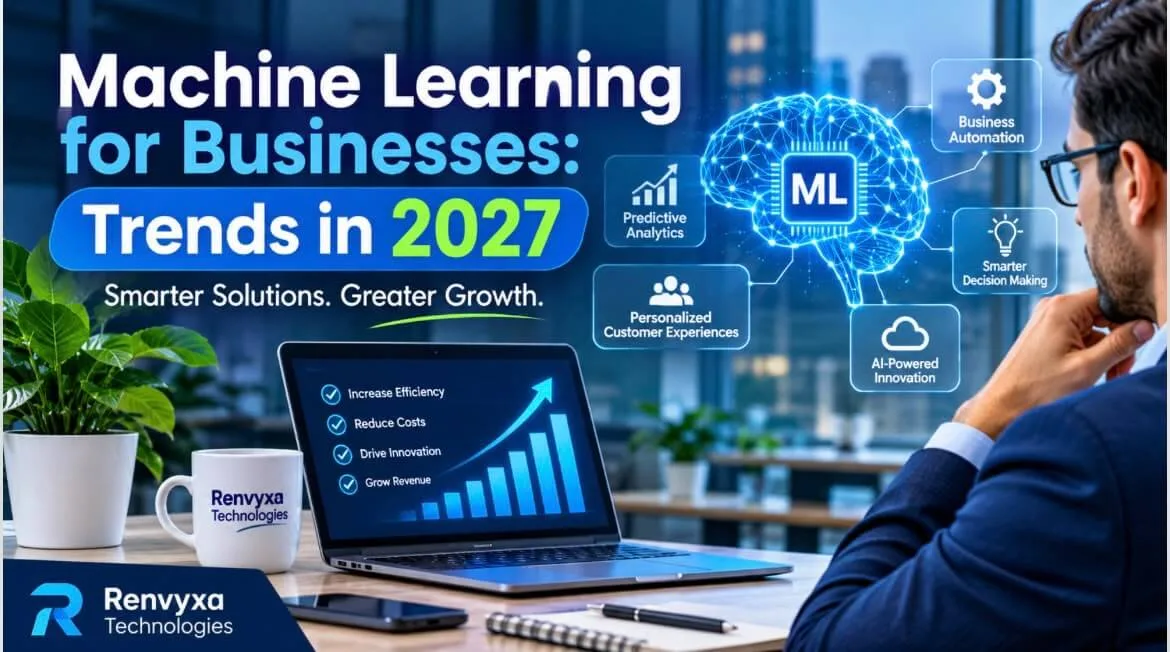
"Discover how machine learning is transforming modern businesses in 2027 through AI automation, predictive analytics, smarter CRM systems, and data-driven solutions that improve efficiency and support business growth."
Introduction
Machine Learning for Businesses technology is changing the way businesses operate, communicate with customers, and make important decisions. Organizations across different industries are adopting intelligent technologies to improve productivity, reduce manual work, and remain competitive.
One of the most important technologies behind this transformation is Machine Learning (ML).
Machine Learning is a branch of Artificial Intelligence (AI) that enables computer systems to learn from data, recognize patterns, and improve their performance without requiring developers to program every individual decision manually.
In 2027, Machine Learning is becoming increasingly relevant to business operations, including customer relationship management, financial analysis, marketing, healthcare, manufacturing, and software development.
Businesses can use machine learning models to analyze large datasets, understand customer behavior, identify potential risks, and support more informed decisions.
What Is Machine Learning?
Machine Learning is a technology that allows computer systems to identify patterns in information and use those patterns to make predictions or generate useful outputs.
Traditional software generally follows instructions written by developers. Machine Learning systems take a different approach by learning from examples and historical data.
For instance, an online shopping platform can analyze previous customer purchases and product interactions to recommend products that may interest individual users.
Similarly, a financial organization can use machine learning models to identify unusual transaction patterns that may require further investigation.
According to Google's Machine Learning Introduction, machine learning models use data to make predictions and generate outputs.
How Does Machine Learning Work?
Machine Learning systems generally follow several important steps.
1. Data Collection
The first step is collecting relevant information from different sources.
Businesses may gather data from:
Customer databases.
Website analytics.
Sales records.
Financial transactions.
Mobile applications.
Enterprise software.
Customer support platforms.
The collected information provides the foundation for training machine learning models.
2. Data Preparation
Raw data may contain duplicate entries, missing values, and inconsistent information.
Before training a model, developers prepare and organize the dataset to make it suitable for analysis.
Good data preparation helps improve model performance and reduces potential errors.
3. Model Training
During model training, machine learning algorithms analyze historical examples to identify patterns and relationships.
The selected algorithm depends on the business problem.
For example, a company predicting future sales may use regression models, while a business identifying suspicious transactions may use classification techniques.
Google's Supervised Learning Guide explains how models learn from labeled examples to make predictions.
4. Model Evaluation
After training, developers evaluate the model using appropriate testing methods.
This process helps determine whether the model can make reliable predictions on information it has not previously processed.
5. Deployment and Monitoring
Once a model meets the required performance standards, it can be integrated into a business application or operational system.
Developers must continue monitoring its performance because data patterns and business requirements can change over time.
Types of Machine Learning
Machine Learning includes different approaches designed to solve different problems.
Supervised Learning
Supervised learning uses labeled training data. This means the model learns from examples where the correct outcome is already known.
For example, an email classification system can learn to distinguish spam messages from legitimate emails using previously labeled examples.
Common applications include fraud detection, sales forecasting, and customer classification.
Unsupervised Learning
Unsupervised learning works with information that does not have predefined labels.
The algorithm attempts to identify hidden patterns, similarities, and groups within the dataset.
Businesses can use this approach for customer segmentation, purchasing behavior analysis, and identifying relationships between products.
Reinforcement Learning
Reinforcement learning involves an agent learning through interactions with an environment.
The system receives feedback in the form of rewards or penalties and adjusts its behavior to improve performance over time.
It has applications in robotics, resource optimization, and certain automated decision-making systems.
For additional learning, businesses and developers can explore Google's Machine Learning Crash Course.
7 Ways Machine Learning Is Transforming Modern Businesses
Practical applications of Machine Learning for Businesses span across customer service, finance, and daily operations machine Learning is creating opportunities across different industries. Here are seven important applications.
1. Customer Relationship Management
Customer Relationship Management (CRM) systems help organizations manage customer information, communication, sales activities, and business relationships.
Machine Learning can make CRM platforms more intelligent by analyzing customer interactions and identifying useful patterns.
Businesses can use machine learning capabilities to:
Identify potential sales opportunities.
Improve lead scoring.
Analyze customer engagement.
Support customer segmentation.
Estimate customer churn risk.
Recommend relevant follow-up activities.
For example, a CRM platform may identify customers whose engagement has decreased over time. Sales teams can use this information to prioritize communication and develop suitable retention strategies.
Businesses interested in intelligent CRM platforms can explore AI and CRM Development Services by Renvyxa Technologies.
2. Business Automation
Many businesses still depend on repetitive manual processes that consume valuable time.
Machine Learning can support automation by helping software systems recognize patterns, classify information, and make predictions.
Examples include document classification, automated customer support routing, demand forecasting, and intelligent workflow management.
When integrated with suitable business applications, these capabilities can reduce repetitive work and help employees focus on more important responsibilities.
3. Marketing and Customer Personalization
Understanding customer preferences is essential for successful marketing.
Machine Learning models can analyze browsing behavior, purchasing histories, and engagement patterns to identify customer interests.
Businesses can use these insights to:
Improve product recommendations.
Develop customer segments.
Personalize marketing campaigns.
Analyze customer engagement.
Identify potential purchasing patterns.
Personalization should also respect customer privacy and applicable data protection requirements.
4. Financial Analysis and Fraud Detection
Financial organizations process large volumes of transactions and financial information.
Machine Learning can help analyze transaction patterns and identify activities that differ from normal behavior.
For example, a financial institution may use machine learning models to flag unusual transactions for additional investigation.
Other applications include credit risk assessment, financial forecasting, and transaction monitoring.
These systems should support qualified financial professionals and established risk management procedures.
5. Healthcare Operations
Healthcare providers manage large amounts of information through patient records, appointments, medical reports, and operational systems.
Machine Learning can support healthcare operations by helping organizations analyze information and improve resource planning.
Potential applications include:
Patient admission forecasting.
Appointment demand prediction.
Medical image analysis.
Healthcare resource planning.
Administrative workflow optimization.
Healthcare applications involving patient information require strong privacy protections, appropriate validation, and professional oversight.
6. E-commerce and Retail
Online retailers can use Machine Learning to understand purchasing patterns and improve shopping experiences.
Recommendation systems are a common example.
These systems analyze customer interactions and product information to suggest items that may be relevant to individual shoppers.
Retail businesses can also use machine learning for inventory planning, demand forecasting, customer segmentation, and sales analysis.
7. Manufacturing and Predictive Maintenance
Manufacturing businesses depend on equipment and production systems that must operate efficiently.
Machine Learning can analyze equipment performance data to identify patterns associated with possible failures.
Predictive maintenance systems can help manufacturers plan inspections and maintenance activities before certain equipment problems become serious.
Machine Learning can also support production forecasting, quality control, and supply chain optimization.
Benefits of Machine Learning for Businesses
Adopting Machine Learning for Businesses creates measurable advantages in speed, accuracy, and customer satisfaction. Implementing Machine Learning can provide several practical advantages.
Improved Decision-Making
Machine Learning helps organizations analyze information and identify patterns that may not be immediately visible through manual analysis.
This can support more informed business planning.
Greater Operational Efficiency
Automating suitable repetitive processes can reduce manual workloads and help employees concentrate on higher-value activities.
Better Customer Experiences
Businesses can use machine learning insights to develop more relevant recommendations, personalized communication, and improved customer support.
Data-Driven Business Strategies
Organizations can use historical information and predictive models to evaluate potential business opportunities and risks.
Scalable Digital Operations
When implemented through suitable software architecture, Machine Learning capabilities can become part of applications that support growing business requirements.
Challenges of Implementing Machine Learning
Although Machine Learning offers significant opportunities, successful implementation requires careful planning.
Data Quality: Poor-quality information can reduce model accuracy and produce misleading results.
Data Privacy: Businesses must protect customer and organizational information and comply with applicable privacy regulations.
Integration Complexity: Connecting machine learning systems with existing CRM platforms, databases, and enterprise applications may require custom development.
Development Costs: Infrastructure, data preparation, skilled developers, testing, and maintenance can require significant investment.
Model Monitoring: Machine learning models may become less accurate when real-world data patterns change.
Businesses should establish clear objectives, appropriate security measures, and continuous evaluation processes before deploying machine learning solutions.
Machine Learning vs. Traditional Software Development
Traditional software development generally relies on predefined rules and instructions written by developers.
Machine Learning introduces models that can learn patterns from data and generate predictions based on those patterns.
For example, a traditional inventory application may use fixed rules to generate low-stock alerts.
A machine learning-based inventory system may analyze historical sales, seasonal patterns, and purchasing behavior to estimate future inventory requirements.
Both approaches have important roles in modern software development.
In many business applications, combining traditional software engineering with machine learning provides a practical way to develop reliable and intelligent digital solutions.
The Future of Machine Learning in 2027 and Beyond
Machine Learning is expected to remain an important part of business technology development.
Several areas are attracting increasing attention.
AI Agents and Intelligent Automation
AI agents can use machine learning capabilities and other AI technologies to understand tasks, interact with software tools, and support defined workflows.
Businesses may use these systems to improve customer support, information processing, and internal operations.
Generative AI Integration
Generative AI systems can work alongside machine learning-based applications to support content generation, information analysis, and software development workflows.
Advanced Predictive Analytics
Organizations can use machine learning models to analyze historical information and estimate possible future business outcomes.
Custom AI Software
Businesses may increasingly explore custom applications that combine machine learning, automation, and existing enterprise systems.
Responsible AI Development
As machine learning adoption grows, organizations will need to pay greater attention to transparency, privacy, security, fairness, and human oversight.
The long-term success of these technologies will depend on how responsibly and effectively they are implemented.
How Renvyxa Technologies Supports Modern Business Innovation
Adopting Machine Learning requires more than simply using an AI tool. Businesses need suitable software architecture, secure data management, reliable integrations, and solutions designed around their operational requirements.
Renvyxa Technologies focuses on AI and CRM development services, helping businesses explore modern software and digital transformation opportunities.
Organizations interested in intelligent business applications can explore solutions such as:
Custom AI-powered software development.
CRM development and integration.
Business workflow automation.
Enterprise software development.
Custom digital solutions for business operations.
Every organization has different requirements. A suitable technology strategy should begin with identifying business challenges and selecting solutions that provide practical value.
Businesses interested in exploring AI and CRM development services can visit Renvyxa Technologies to learn more.
Conclusion
Machine Learning is transforming how modern businesses analyze information, understand customers, automate workflows, and make decisions.
From CRM development and financial analysis to healthcare operations, manufacturing, and e-commerce, its applications continue to expand across industries.
However, successful adoption requires reliable data, appropriate software infrastructure, continuous monitoring, and responsible implementation.
As organizations continue investing in digital transformation throughout 2027 and beyond, Machine Learning will remain an important technology for building intelligent and scalable business applications.
Businesses that understand its capabilities and implement it strategically can create stronger foundations for innovation and long-term growth.
 AI & Innovation
Top Open Source AI Tools You Should Try in 2026
Discover the top open source AI tools of 2026. Explore powerful, privacy-focused...
 ARTIFICIAL INTELLIGENCE
Cost to Build an Enterprise AI Agent in 2026: Pricing Breakd...
What is the real cost to build an enterprise AI agent in 2026? From MVP proof-of...
 CYBERSECURITY
Cloud Data Protection Strategies for Modern Enterprises in 2...
Learn key cloud data protection strategies to secure enterprise infrastructure,...
 Technology / Digital Marketing
The Ultimate Guide to AI Marketing Tools: How to Scale Your...
Explore the ultimate guide to top AI marketing tools, learn how to scale your te...
 DIGITAL MARKETING
AI Copy-writing Tools for Digital Marketing: How to Scale Co...
Learn how AI copy-writing tools for digital marketing help businesses scale cont...
 DIGITAL MARKETING
Why Guest Posting Is Important for SEO in 2026
Learn why guest posting is important for SEO in 2026. Build high DA back-links a...