
How Autonomous AI Agents for Business Cut Costs & Scale Operations in 2027

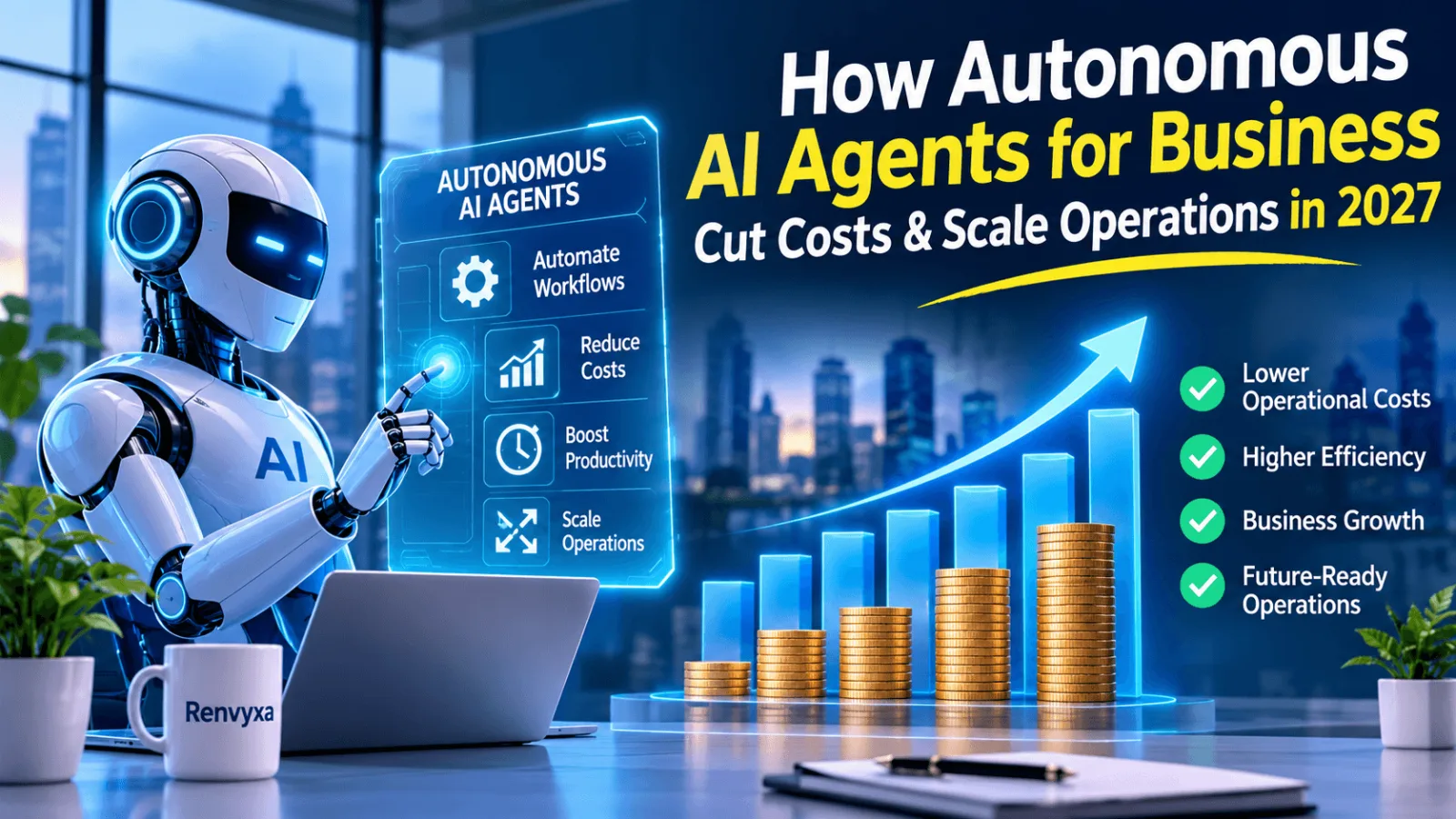
"Discover how autonomous AI agents for business automate complex workflows, cut operational costs, and scale enterprise operations in 2027 without manual bottlenecks."
Autonomous ai agents for busines are entering a new era of digital transformation, where artificial intelligence is becoming more than just a tool for answering questions or generating content. In 2027, autonomous AI agents are expected to play a much bigger role in helping organizations manage daily operations, reduce expenses, improve productivity, and support long-term growth. Unlike traditional automation systems that follow fixed instructions,autonomous AI agents for business autonomous AI agents can analyze information, make decisions within defined boundaries, and complete multi-step tasks with minimal human intervention.
For companies looking to remain competitive, adopting intelligent automation is becoming an important part of business planning. From customer service and sales management to manufacturing and financial operations, AI-powered agents can help businesses work more efficiently while making better use of available resources.
Organizations such as Renvyxa can help businesses explore modern digital solutions and understand how technology can support more efficient operations. By combining AI capabilities with well-designed business systems, companies can build workflows that are flexible, scalable, and prepared for future demands.
What Are Autonomous AI Agents for Business?
Autonomous AI agents are intelligent software systems designed to perform tasks, evaluate information, and take actions toward specific objectives. They can interact with business applications, analyze data, communicate with other software systems, and adjust their actions based on changing conditions.
Traditional automation usually depends on predefined rules. For example, a basic automation tool might send an email whenever a customer completes a purchase. An autonomous AI agent can go further by reviewing customer information, identifying potential issues, preparing a personalized response, updating relevant records, and escalating complicated requests to a human employee.
These capabilities make AI agents useful across different departments, including:
Customer support and relationship management.
Sales and marketing operations.
Inventory and supply chain management.
Financial reporting and administration.
Human resources and recruitment.
Manufacturing and production planning.
The main advantage is that businesses can automate more complex processes without removing human oversight from important decisions.
1. Reducing Operational Costs Through Intelligent Automation
One of the biggest advantages of autonomous AI agents is their potential to reduce operational expenses. Many companies spend significant amounts of money managing repetitive administrative activities, processing information, responding to routine inquiries, and coordinating internal workflows.
AI agents can take responsibility for suitable repetitive tasks, allowing employees to concentrate on activities that require creativity, experience, and strategic thinking.
For example, an AI-powered support agent can answer common customer questions, retrieve order information, and guide users through basic troubleshooting steps. More complicated cases can automatically be transferred to a human representative.
Businesses may benefit from:
Lower administrative workloads.
Reduced manual data entry.
Faster processing of routine requests.
Fewer repetitive operational tasks.
Better utilization of employee time.
These improvements can help organizations manage growing workloads without increasing staffing costs at the same rate.
However, successful automation requires proper implementation, monitoring, and maintenance. Companies should evaluate the total cost of AI systems, including integration, security, and ongoing oversight.
Top 5 Business Workflows for autonomous ai agents for business
Customer relationships are essential to sustainable business growth. Managing customer information across different platforms can become difficult, particularly when a company handles hundreds or thousands of interactions every day.
Autonomous AI agents can improve customer relationship management by collecting relevant information, organizing customer records, identifying potential sales opportunities, and supporting personalized communication.
For instance, an AI agent connected to a CRM platform could identify customers who have not interacted with a business recently and recommend appropriate follow-up actions. It could also summarize previous conversations so sales representatives have the information they need before contacting a customer.
Businesses investing in advanced CRM systems can explore custom CRM development in 2027 to understand how tailored customer management solutions support changing operational requirements.
When AI agents and CRM platforms work together, companies can improve communication, reduce manual workloads, and create more consistent customer experiences.
3. Scaling Business Operations Without Increasing Complexity
Business growth often creates operational challenges. More customers mean additional support requests, more transactions, larger databases, and increased pressure on internal teams.
Traditional business processes may struggle to handle this growth efficiently. Companies sometimes respond by hiring additional employees or introducing more software tools, which can increase operational complexity.
Autonomous AI agents offer another approach. They can support larger workloads by handling multiple tasks simultaneously, coordinating information between applications, and helping teams manage repetitive processes.
For example, an e-commerce company could use AI agents to monitor incoming orders, identify potential inventory shortages, prepare customer notifications, and update internal systems.
This allows businesses to expand their operations while keeping workflows organized.
Scalability also depends on having reliable infrastructure, clear operational policies, and systems that can communicate effectively. AI agents should complement these foundations rather than replace them.
4. Optimizing Manufacturing and Production Planning
Manufacturing businesses operate in environments where efficiency, timing, inventory, and resource allocation directly influence profitability. Even small planning mistakes can create delays, unnecessary expenses, and production bottlenecks.
Autonomous AI agents can help manufacturing teams analyze production information, monitor resource availability, identify scheduling conflicts, and recommend adjustments.
For example, an AI agent could review machine availability, current inventory levels, workforce schedules, and customer demand before suggesting an improved production plan.
This can help manufacturers:
Reduce production delays.
Identify resource utilization problems.
Improve inventory planning.
Minimize unnecessary operational waste.
Respond more quickly to changing demand.
Businesses interested in improving these processes can also explore innovative approaches to streamline manufacturing capacity planning.
Combining capacity planning systems with AI-driven analysis can help organizations make more informed decisions and improve coordination between production departments.
5. Making Faster, Data-Driven Business Decisions
Business decisions are only as effective as the information behind them. Unfortunately, many organizations collect large amounts of data but struggle to turn it into useful insights.
Autonomous AI agents can analyze information from multiple sources, identify patterns, summarize performance indicators, and highlight potential problems.
For example, an AI agent working with business analytics software could monitor sales performance and identify changes in customer demand. It could notify management when certain products experience declining sales or when inventory levels become unusually high.
These insights can help business leaders:
Identify operational inefficiencies.
Understand customer behavior.
Monitor business performance.
Recognize emerging opportunities.
Make decisions using relevant information.
AI-generated recommendations should still be reviewed when decisions involve significant financial, legal, or operational consequences. Human expertise remains essential for understanding business context.
6. Automating Sales and Marketing Workflows
Sales and marketing departments manage numerous activities, including lead generation, customer communication, campaign management, reporting, and follow-ups.
Autonomous AI agents can support these activities by identifying potential customers, organizing lead information, preparing personalized messages, and monitoring campaign performance.
For example, an AI agent could analyze incoming leads and categorize them based on their interests and previous interactions. It could then recommend the next appropriate action for the sales team.
Marketing teams can also use AI agents to organize campaign data, identify audience trends, and generate performance summaries.
These capabilities can reduce repetitive work while allowing employees to spend more time developing strategies and building meaningful customer relationships.
Businesses should ensure that automated communication follows applicable privacy regulations and that customers have appropriate options for managing their information.
7. Improving Financial Management and Administrative Efficiency
Financial and administrative departments often handle repetitive processes such as invoice organization, expense categorization, payment reminders, and financial reporting.
Autonomous AI agents can assist with these activities by extracting information from documents, identifying unusual transactions, organizing records, and preparing reports for review.
For example, an AI agent could compare incoming invoices against purchase orders and highlight missing information or potential discrepancies.
This can help finance teams process routine documentation more efficiently while reducing manual errors.
However, sensitive financial actions should require appropriate permissions and human approval. Businesses should also maintain clear audit trails to ensure that automated decisions remain transparent and accountable.
8. Strengthening Business Operations With Human-AI Collaboration
Although autonomous AI agents can perform many tasks independently, the most effective business strategies combine artificial intelligence with human expertise.
Employees understand business priorities, customer expectations, company culture, and complex situations that automated systems may not fully recognize.
AI agents are most useful when they handle repetitive activities and provide relevant information that helps employees make better decisions.
For successful implementation, businesses should establish:
Clear responsibilities for AI agents.
Access controls and permission limits.
Human approval for sensitive actions.
Regular performance monitoring.
Data protection and security policies.
Procedures for correcting automated errors.
This approach helps organizations benefit from automation without sacrificing accountability or service quality.
9. How Businesses Can Prepare for Autonomous AI Agents in 2027
Adopting autonomous AI technology requires more than purchasing software. Companies need a practical implementation strategy that aligns with their business objectives.
The following steps can help organizations prepare:
Identify repetitive processes: Start by identifying tasks that consume significant employee time and follow predictable workflows.
Choose suitable AI solutions: Select systems that support the company's operational requirements and integrate with existing applications.
Start with a pilot project: Introduce AI agents into one department or workflow before expanding automation across the organization.
Establish security controls: Define data access permissions, approval requirements, and monitoring procedures.
Measure performance: Track operational costs, processing times, error rates, employee productivity, and customer satisfaction.
Expand gradually: Use the results of initial projects to identify additional opportunities for automation.
A structured approach helps businesses avoid unnecessary investment and makes it easier to understand the actual value of AI adoption.
The Future of Autonomous AI Agents in Business
By 2027, autonomous AI agents are likely to become increasingly integrated into everyday business software and operational systems. Improvements in reasoning capabilities, application integration, and workflow coordination will create new opportunities for companies across different industries.
Businesses may increasingly use multiple specialized AI agents that collaborate on larger processes. One agent might manage customer requests, another could monitor inventory, and a third could prepare operational reports. Together, these systems could support more connected and responsive business operations.
Nevertheless, organizations will need to address important challenges, including data security, system reliability, implementation costs, regulatory requirements, and the possibility of inaccurate automated decisions.
Companies that approach AI adoption strategically will be better positioned to benefit from these developments.
How to Evaluate Whether an Intelligent Marketing Platform Can Learn and Adapt Across Campaign Types vs. Needing Specialized AI Tools?
To evaluate whether an intelligent marketing platform can adapt across different campaign types, test how well it shares unified customer data, learns from cross-channel conversion signals, and adjusts targeting without manual rule rewrites. When campaigns require deep, niche execution—such as specialized creative production, technical SEO auditing, or complex attribution modeling—combining a core adaptive platform with dedicated specialized AI tools often delivers better accuracy and control than relying on a single all-in-one system.
Conclusion
Autonomous AI agents offer businesses an opportunity to reduce repetitive workloads, improve operational efficiency, strengthen customer relationships, and support scalable growth. Their ability to coordinate complex workflows and analyze business information makes them valuable for organizations seeking more efficient ways to operate in 2027.
From CRM management and manufacturing capacity planning to financial administration and customer support, AI agents can improve how different departments work together. The key is to implement these systems with clear objectives, appropriate security controls, and human oversight.
As business technology continues to evolve, organizations that combine intelligent automation with effective management strategies can build more productive, adaptable, and competitive operations for the future.
Explore Renvyxa to learn more about modern business technology and digital solutions that support long-term organizational growth.
 Machine Learning
 for Businesses: Trends in 2027
Discover how machine learning is transforming modern businesses in 2027 through...
 AI & Innovation
Top Open Source AI Tools You Should Try in 2026
Discover the top open source AI tools of 2026. Explore powerful, privacy-focused...
 ARTIFICIAL INTELLIGENCE
Cost to Build an Enterprise AI Agent in 2026: Pricing Breakd...
What is the real cost to build an enterprise AI agent in 2026? From MVP proof-of...
 CYBERSECURITY
Cloud Data Protection Strategies for Modern Enterprises in 2...
Learn key cloud data protection strategies to secure enterprise infrastructure,...
 Technology / Digital Marketing
The Ultimate Guide to AI Marketing Tools: How to Scale Your...
Explore the ultimate guide to top AI marketing tools, learn how to scale your te...
 DIGITAL MARKETING
AI Copy-writing Tools for Digital Marketing: How to Scale Co...
Learn how AI copy-writing tools for digital marketing help businesses scale cont...
 DIGITAL MARKETING
Why Guest Posting Is Important for SEO in 2026
Learn why guest posting is important for SEO in 2026. Build high DA back-links a...