
AI Copy-writing Tools for Digital Marketing: How to Scale Content Like a Pro
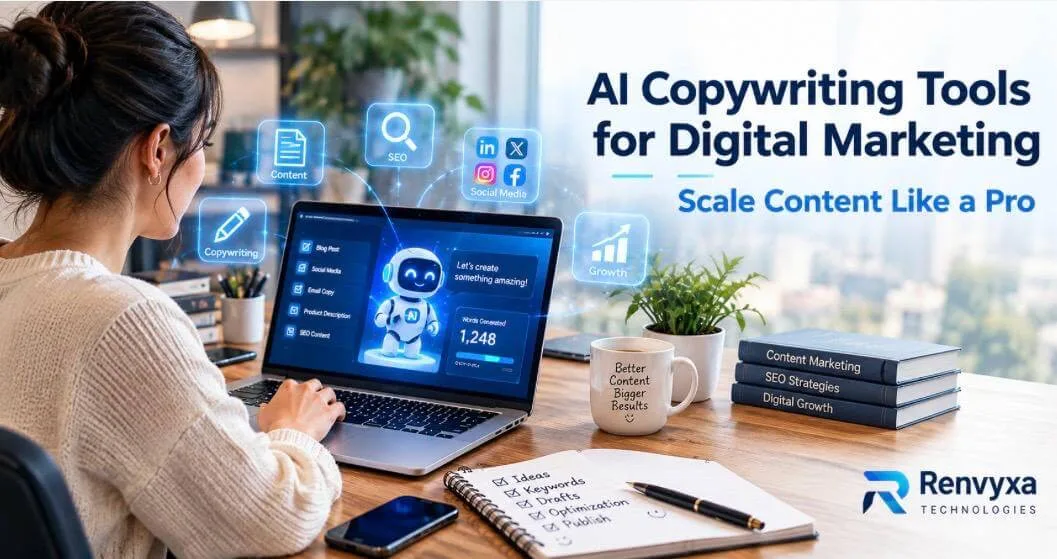
"Learn how AI copy-writing tools for digital marketing help businesses scale content, improve SEO, and combine AI speed with human creativity. Renvyxa Technologies can help you grow."
AI copywriting tools for digital marketingCreating high-quality content consistently is one of the biggest challenges facing modern businesses. Whether you are running an eCommerce store, SaaS company, professional services firm, technology startup, or digital agency, your audience expects useful, original, relevant, and engaging content across multiple channels.
The problem is that producing this volume of content manually takes significant time and resources.
This is where AI copywriting tools for digital marketing are changing the way businesses approach content creation. In 2026, artificial intelligence can help marketers research topics, generate content ideas, create initial drafts, personalize messaging, improve readability, and scale campaigns without sacrificing strategic direction.
However, AI should not replace human creativity. The most effective approach combines AI's speed with human expertise, editorial judgment, brand knowledge, and original insights.
For businesses targeting competitive Tier-1 markets such as the US, UK, Canada, and Australia, this combination can create a major advantage. Instead of choosing between speed and quality, marketers can build a smarter workflow that delivers both.
AI copywriting tools for digital marketing
Content marketing has changed dramatically over the last decade.
Traditional content production usually involved keyword research, competitor analysis, outlining, writing, editing, proofreading, formatting, publishing, and promotion. Every article or campaign could require several hours—or even days—to complete.
AI is transforming many of these processes.
Modern AI copywriting tools for digital marketing can assist marketers at almost every stage of the content workflow. Instead of starting with a blank page, writers can use AI to generate topic ideas, create outlines, suggest headlines, summarize research, develop variations of advertising copy, and produce preliminary drafts.
From Manual Drafting to Intelligent Assistance
The biggest advantage of AI is not simply that it can write words quickly. Its real value comes from reducing repetitive work.
For example, a digital marketing team creating a campaign might use AI to generate:
Blog topic ideas
SEO-friendly content outlines
Meta titles and descriptions
Social media captions
Email subject lines
Product descriptions
Landing page variations
Ad copy variations
FAQ sections
Content briefs
Internal linking suggestions
A human marketer can then review, improve, fact-check, and personalize the output.
This creates a more efficient workflow where technology handles repetitive tasks while people focus on strategy and creativity.
Why AI Alone Is Not Enough
Publishing raw AI-generated content without meaningful human review can create problems.
Content may sound generic, repeat common ideas, lack first-hand experience, or fail to communicate a company's unique perspective. In competitive search results, simply producing more words is rarely enough.
The goal should therefore be AI-assisted content creation, not content created without human involvement.
The strongest workflow looks something like this:
Research → AI-assisted draft → Human expertise → Optimization → Editorial review → Publication → Performance analysis
This process allows businesses to increase production without turning their websites into collections of generic content.
Why Tier-1 Markets Demand Smarter Copywriting Workflows
Businesses competing in the US, UK, Canada, and Australia operate in some of the world's most competitive digital markets.
Customers have access to thousands of websites, brands, products, reviews, advertisements, and social media accounts. As a result, simply publishing content is not enough.
Brands need content that is relevant, useful, trustworthy, personalized, and easy to understand.
Audiences Expect Value
Modern users are increasingly selective about what they read.
A visitor landing on a business website wants an immediate answer to their question. They do not want unnecessary filler or an article that appears to have been created only to target keywords.
AI can help marketers produce content faster, but the content still needs a clear purpose.
Before creating an article, ask:
Who is this content for?
What problem does it solve?
What information does the reader actually need?
What makes our perspective different?
What action should the reader take afterward?
Answering these questions gives AI-generated drafts a strategic foundation.
Speed Matters in Competitive Markets
Digital trends move quickly.
A topic that is trending today may become significantly less relevant a few months later. Businesses therefore need content workflows that allow them to respond quickly.
AI can help marketing teams move from idea to first draft much faster.
For example, a software company launching a new AI product might need:
A launch announcement.
A detailed product page.
A comparison article.
Several educational blog posts.
Email campaign copy.
LinkedIn content.
Paid advertising variations.
FAQ content.
Creating all of this manually can take substantial time.
AI-assisted workflows can accelerate the initial production process while human marketers maintain control over positioning and quality.
Personalization at Scale
Another major advantage is personalization.
Instead of creating one generic message for every customer, businesses can develop different variations based on:
Industry
Customer intent
Location
Buying stage
Product interest
Search behavior
Customer pain points
For Tier-1 audiences, this level of relevance can make marketing communication feel significantly more useful.
Top Strategies to Combine AI Speed with Human Creativity
The best results from AI copywriting come from combining automation with human judgment.
Here are several strategies businesses can use.
1. Build a Strong Brand Voice
AI needs direction.
If every prompt produces a completely different tone, your website and marketing channels can quickly become inconsistent.
Create clear brand guidelines covering:
Tone
Vocabulary
Sentence length
Writing style
Audience
Industry terminology
Words to avoid
Brand personality
Preferred calls to action
For example, a B2B technology company may want a professional, confident, educational tone, while a lifestyle brand might use a more conversational and inspirational voice.
The more clearly you define your brand voice, the easier it becomes to use AI copywriting tools for digital marketingconsistently.
2. Add Original Insights
AI can summarize existing information, but businesses should contribute something unique.
Add:
Original examples
Expert opinions
Customer experiences
Case studies
Industry observations
Unique data
Practical recommendations
First-hand expertise
This makes content more valuable and helps distinguish it from generic information already available online.
3. Follow E-E-A-T Principles
Search engines increasingly emphasize useful and trustworthy content.
E-E-A-T refers to:
Experience
Expertise
Authoritativeness
Trustworthiness
AI-assisted content should therefore be reviewed by people who understand the subject.
For a cybersecurity article, for example, technical claims should be checked by someone with appropriate knowledge. For financial or legal topics, accuracy and credibility are particularly important.
AI can accelerate writing, but human expertise provides the layer of trust that generic automation cannot replace.
4. Use AI for Variations, Not Just Articles
Many marketers think about AI primarily as a blog-writing tool.
Its usefulness goes much further.
One well-researched article can become:
A LinkedIn post
An email newsletter
Multiple social posts
A short video script
An infographic outline
An FAQ section
A sales email
A downloadable guide
Several short-form educational posts
This is known as content repurposing.
Instead of constantly creating new ideas from scratch, marketers can turn one strong piece of content into an entire campaign.
Best Practices for Technical SEO Integration
AI-generated content still needs proper SEO.
Search optimization should not be treated as an afterthought. Technical and on-page SEO should be integrated into the content workflow from the beginning.
Start With Search Intent
Before writing, identify what the user actually wants.
Search intent generally falls into categories such as:
Informational
Navigational
Commercial
Transactional
For example, someone searching for "best AI copywriting tools" may be researching options, while someone searching for "AI copywriting agency" may already be looking for a service provider.
Your content should match that intent.
Use Keywords Naturally
The target keyword AI copywriting tools for digital marketing should appear naturally in important areas such as:
Page title
H1
Introduction
Relevant H2 or H3 headings
Body content
Conclusion
Meta title
Meta description
However, avoid keyword stuffing.
Search engines are sophisticated enough to understand related concepts and context. Supporting terms such as AI content creation, digital marketing automation, SEO content, content scaling, copywriting automation, and AI marketing tools can help establish topical relevance when used naturally.
Optimize Content Structure
A well-structured article is easier for both readers and search engines to understand.
Use:
One clear H1
Descriptive H2 headings
Relevant H3 subheadings
Short paragraphs
Bullet points
Numbered lists
Clear examples
Internal links
Descriptive anchor text
Large blocks of text can discourage users from reading, particularly on mobile devices.
Improve Metadata
Every important page should have an optimized title tag and meta description.
For example:
Metadata should accurately represent the page rather than simply repeating keywords.
Strengthen Internal Linking
Internal links help users discover related content while helping search engines understand the structure of a website.
A well-planned internal linking structure can improve navigation and distribute authority across important pages.
Don't Ignore Technical Performance
Excellent copy cannot compensate for a poor website experience.
Businesses should also pay attention to:
Mobile responsiveness
Page speed
Core Web Vitals
HTTPS security
Crawlability
Indexability
XML sitemaps
Canonical URLs
Structured data where appropriate
Broken links
SEO works best when content quality and technical performance support each other.
How to Build a Scalable AI Content Workflow
Businesses looking to scale can create a repeatable process.
Step 1: Research
Identify audience needs, search intent, competitors, keywords, and content gaps.
Step 2: Create a Content Brief
Define the target audience, primary keyword, secondary topics, article structure, desired tone, and conversion goal.
Step 3: Generate an AI-Assisted Draft
Use AI to create the first version based on the strategic brief.
Step 4: Add Human Expertise
Insert original insights, examples, opinions, data, experiences, and brand-specific information.
Step 5: Optimize for SEO
Improve headings, keyword placement, internal links, metadata, readability, and search intent alignment.
Step 6: Fact-Check and Edit
Review claims, statistics, technical information, grammar, tone, and overall accuracy.
Step 7: Publish and Measure
Track organic traffic, rankings, engagement, conversions, and other relevant KPIs.
Step 8: Improve Over Time
Content should not be considered finished forever.
Update successful pages as new information, trends, products, and customer needs emerge.
Practical Example: Turning One Idea Into a Full Campaign
Imagine an Australian software company wants to promote its business automation services.
Instead of writing one blog post and stopping there, its marketing team could use an AI-assisted workflow to develop a complete campaign.
The central topic might be:
"How Business Automation Helps Small Companies Save Time."
From that single idea, the team could create:
A 1,500-word SEO article
A LinkedIn post
Five short social media posts
An email newsletter
Three advertising variations
A landing page section
A customer FAQ
A short video script
Human editors can then refine each asset for the company's audience and brand voice.
This is where AI copywriting tools for digital marketing become particularly powerful. They do not simply create individual pieces of copy; they can help businesses build scalable content systems.
Conclusion & Actionable Takeaway
The future of content marketing is not about choosing between humans and artificial intelligence.
It is about combining the strengths of both.
AI copywriting tools for digital marketing can help businesses research faster, generate ideas, produce drafts, personalize campaigns, repurpose content, and scale marketing operations. But human creativity, expertise, strategic thinking, fact-checking, and brand knowledge remain essential.
For companies competing in the US, UK, Canada, and Australia, a scalable content strategy can create a significant competitive advantage. The brands that succeed will not necessarily be the ones publishing the most content. They will be the ones creating the most useful, relevant, trustworthy, and strategically optimized content at scale.
If you want to turn AI-powered content creation into a complete digital growth strategy, Renvyxa Technologies can help.
From SEO and content strategy to AI-powered solutions, digital marketing, and business-focused technology services, Renvyxa helps businesses build stronger digital foundations and reach the right audiences.
Ready to scale your digital presence?
Visit https://renvyxa.com/ to explore Renvyxa Technologies' services and discover how strategic SEO, AI, content, and digital marketing solutions can help your business grow in competitive global markets
 CYBERSECURITY
Cloud Data Protection Strategies for Modern Enterprises in 2...
Learn key cloud data protection strategies to secure enterprise infrastructure,...
 Technology / Digital Marketing
The Ultimate Guide to AI Marketing Tools: How to Scale Your...
Explore the ultimate guide to top AI marketing tools, learn how to scale your te...
 DIGITAL MARKETING
7 White-Hat Link Building Strategies That Actually Work
Learn 7 white-hat link building strategies that actually work. Build high-qualit...
 DIGITAL MARKETING
Why Guest Posting Is Important for SEO in 2026
Learn why guest posting is important for SEO in 2026. Build high DA back-links a...
 DIGITAL MARKETING
How AI Solutions are Transforming Small Businesses in 2026
how AI Solutions and Machine Learning are transforming small businesses in 2026....
 Technology / Digital Marketing
The Ultimate Guide to AI Marketing Tools: How to Scale Your...
Explore the ultimate guide to top AI marketing tools, learn how to scale your te...