
Enterprise Cloud Security Architecture 2027
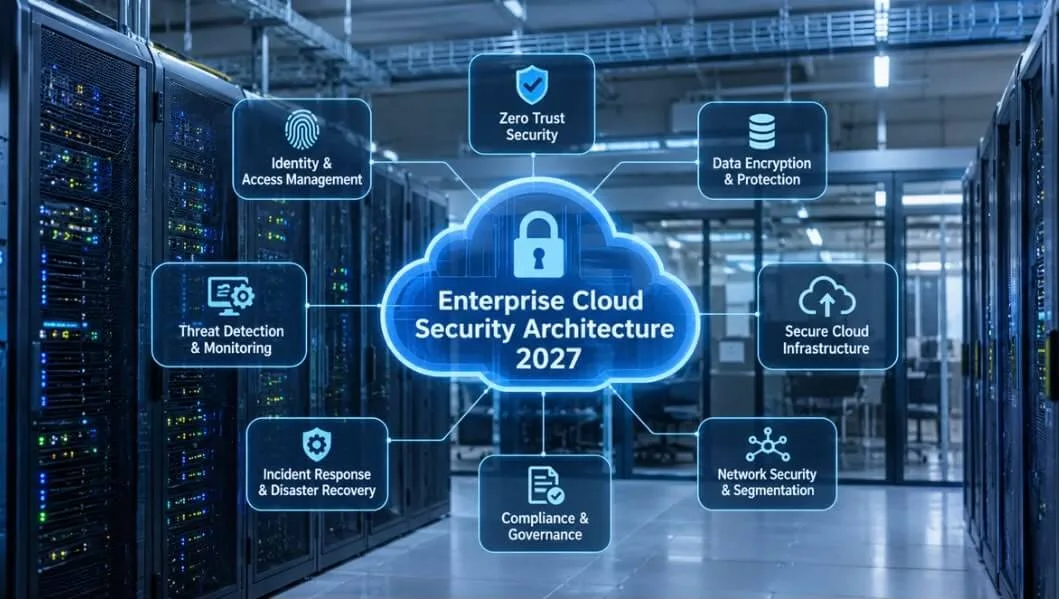
"Learn essential enterprise cloud security architecture strategies for 2027, including identity governance, micro-segmentation, continuous verification, and threat mitigation."
Introduction
Implementing an enterprise cloud security architecture in 2027 is essential for modern organizations Cloud computing has become an essential part of modern business operations. Organizations use cloud platforms to store sensitive information, manage applications, support remote employees, and deliver digital services to customers. As businesses continue to adopt cloud technology, protecting their digital infrastructure has become more important than ever.
However, cloud environments also introduce security challenges, including unauthorized access, data breaches, insecure configurations, and increasingly sophisticated cyberattacks. Companies using multiple cloud platforms must ensure that their applications, networks, databases, and user accounts remain protected.
In 2027, enterprise cloud security architecture will continue to focus on zero-trust security, identity management, data encryption, artificial intelligence, automated threat detection, and regulatory compliance.
A strong security architecture helps organizations protect confidential information, reduce operational risks, and maintain customer trust. This article explores the most important enterprise cloud security best practices businesses should consider in 2027.
What Is Enterprise Cloud Security Architecture?
Enterprise cloud security architecture is a structured framework of technologies, policies, and processes designed to protect cloud-based infrastructure, applications, identities, and data.
It defines how security controls operate across public cloud platforms, private cloud environments, hybrid infrastructure, and software-as-a-service applications.
For example, a company running its customer relationship management system in the cloud must protect customer records, employee accounts, application interfaces, and connected databases. Each component requires appropriate security controls.
A comprehensive cloud security architecture typically includes identity and access management, network protection, encryption, application security, threat monitoring, backup systems, and compliance management.
The goal is to create a secure and reliable environment where businesses can use cloud technology without exposing critical information to unnecessary risks.
1. Implement a Zero-Trust Security Model
Zero trust is one of the most important principles of modern cloud security. Traditional security models often assume that users inside a corporate network can be trusted. However, remote work, cloud applications, and third-party integrations make this assumption increasingly unreliable.
Zero trust follows a different approach: every access request must be verified before permission is granted.
Organizations should implement the following practices:
Require strong authentication for users accessing business applications.
Use multi-factor authentication for sensitive accounts.
Grant users only the permissions necessary for their responsibilities.
Verify device security before allowing access to critical resources.
Monitor unusual login attempts and suspicious account activity.
For example, a software developer may need access to development systems but should not automatically receive administrative permissions over production databases.
Applying zero-trust principles helps reduce unauthorized access and limits the damage that can occur if an account is compromised.
2. Strengthen Identity and Access Management
Identity and access management (IAM) determines who can access cloud resources and what actions they can perform.
Weak passwords, excessive permissions, and poorly managed accounts can expose an entire cloud environment to security threats.
Businesses should use role-based access control to assign permissions according to job responsibilities. Employees, contractors, and applications should receive only the access they genuinely need.
Multi-factor authentication adds another layer of protection beyond passwords. Organizations should prioritize phishing-resistant authentication methods for administrators and users with access to critical systems.
Cloud applications and automated processes also require secure identities. Businesses should avoid storing credentials directly in source code or configuration files. Instead, they should use managed identities, secure secrets-management systems, and short-lived credentials where supported.
Regular access reviews are equally important. Unused accounts should be removed, unnecessary permissions should be revoked, and access should be updated whenever an employee changes roles or leaves the organization.
These measures help organizations reduce identity-related risks and maintain better control over their cloud infrastructure.
3. Protect Cloud Data Through Encryption
Data protection is a central part of enterprise cloud security. Businesses frequently store confidential customer records, financial information, intellectual property, and internal documents in cloud environments.
If this information becomes accessible to unauthorized individuals, organizations may face financial losses, legal consequences, and reputational damage.
Encryption helps protect information by making it unreadable without the appropriate cryptographic keys.
Businesses should implement encryption for data at rest and data in transit. This includes information stored in databases, cloud storage, backups, and files transferred between applications.
Organizations should also establish secure encryption-key management procedures. Access to encryption keys must be restricted, and key rotation and recovery processes should be carefully planned.
Data classification can further strengthen protection. Public information, internal business records, confidential documents, and highly sensitive data should have different access and handling requirements.
Data loss prevention tools can help identify sensitive information and reduce unauthorized transfers. Combined with encryption and appropriate access controls, these measures provide a stronger foundation for cloud data protection.
4. Secure Cloud Networks and Applications
Cloud network security helps control communication between users, applications, databases, and external services.
Organizations should divide their infrastructure into separate security zones. For example, public-facing websites should be separated from internal databases and administrative systems.
Network segmentation reduces unnecessary communication and can limit the movement of attackers if one component becomes compromised.
Businesses should also avoid exposing internal resources directly to the internet unless public access is genuinely required. Administrative interfaces, databases, and sensitive storage services should have carefully restricted access.
Application security is equally important. Companies should integrate security checks throughout the software development lifecycle rather than waiting until an application is ready for release.
Development teams should review source code, scan software dependencies, test authentication mechanisms, and identify vulnerabilities before deployment.
APIs also require strong protection because they connect applications and exchange business information. Proper authentication, authorization, input validation, and rate limiting help reduce the risk of unauthorized access and abuse.
Secure development practices allow organizations to build applications that are more reliable and better prepared to handle modern cybersecurity threats.
5. Use AI for Cloud Threat Detection
Artificial intelligence is becoming increasingly useful in cybersecurity. AI-powered security systems can analyze large volumes of activity and help identify unusual behavior that might otherwise go unnoticed.
For example, a monitoring system may detect repeated login failures followed by a successful login from an unusual location and an unexpected attempt to access sensitive information.
Such activity may indicate a compromised account and require further investigation.
Organizations can use security information and event management platforms, automated alerts, and security analytics to improve threat visibility.
However, AI should support rather than completely replace security professionals. Automated systems can generate false positives, overlook certain threats, or incorrectly classify legitimate activity.
Businesses should establish clear investigation procedures and ensure that important security alerts receive appropriate attention.
Organizations adopting AI applications must also protect the data those systems process. Sensitive information should not be submitted to unapproved AI tools, and AI integrations should receive only the permissions required for their intended functions.
By combining intelligent monitoring with human oversight, businesses can improve their ability to detect and respond to cloud security incidents.
6. Manage Cloud Configurations and Vulnerabilities
Cloud environments change frequently as developers deploy applications, create resources, and modify infrastructure settings. These changes can introduce security weaknesses if they are not properly reviewed.
A cloud security posture management strategy helps organizations identify configuration problems such as publicly accessible storage, excessive permissions, missing encryption, and insecure network rules.
Businesses should establish secure configuration standards for their cloud resources and review important settings regularly.
Infrastructure-as-code tools can help organizations deploy resources using consistent, documented configurations. Security checks can also be incorporated into deployment pipelines to identify potential problems before infrastructure is created.
Vulnerability management is another essential responsibility. Organizations should maintain inventories of their applications, operating systems, container images, and software dependencies.
Security updates should be prioritized according to the severity of vulnerabilities, exposure of affected systems, and potential business impact.
Continuous configuration monitoring helps organizations identify weaknesses earlier and reduce the likelihood of preventable security incidents.
7. Establish Backup and Disaster Recovery Plans
Even organizations with strong security controls can experience cyberattacks, accidental data deletion, software failures, and cloud service interruptions.
Reliable backup and disaster recovery procedures help businesses restore critical information and maintain operations after unexpected incidents.
Organizations should maintain regular backups of important databases, applications, and business documents. Where appropriate, backups should use immutable storage or separate administrative controls to reduce the risk of unauthorized modification or deletion.
Businesses should also establish recovery time objectives (RTOs) and recovery point objectives (RPOs).
The recovery time objective defines how quickly a service should be restored after an interruption. The recovery point objective defines how much data loss, measured in time, the business can tolerate.
Critical applications may require faster recovery and more frequent backups than less important systems.
Most importantly, organizations must test their recovery procedures regularly. A successful backup process does not guarantee that the information can be restored correctly.
Testing helps identify technical problems and ensures that teams understand how to recover essential services when needed.
8. Maintain Compliance and Security Governance
Enterprises must consider the legal, regulatory, and contractual requirements that apply to their cloud environments.
Depending on their industry and operations, organizations may need to consider frameworks and regulations such as ISO/IEC 27001, the NIST Cybersecurity Framework, GDPR, and PCI DSS for applicable payment-card environments.
These standards and regulations have different scopes, and not every requirement applies to every business.
Organizations should identify their specific obligations and establish appropriate security policies.
Important governance practices include maintaining access records, reviewing security configurations, documenting incidents, managing third-party risks, and training employees to recognize common cyber threats.
Businesses should also assess external providers before allowing them to access sensitive systems or information. Vendor reviews should consider security controls, data handling practices, access permissions, and incident notification procedures.
Regular audits help organizations identify weaknesses and verify whether security controls are operating as intended.
Effective governance ensures that cloud security remains an ongoing business responsibility rather than a one-time technical project.
9. Build a Practical Cloud Security Roadmap for 2027
Organizations do not need to implement every security technology simultaneously. A phased approach allows businesses to prioritize important risks and improve their security architecture gradually.
Step 1: Assess the existing environment. Identify cloud accounts, applications, databases, users, external integrations, and publicly exposed resources.
Step 2: Address critical weaknesses. Protect administrator accounts, remove unnecessary public access, correct excessive permissions, and secure sensitive information.
Step 3: Standardize security controls. Establish configuration policies, secure development practices, access requirements, and monitoring procedures.
Step 4: Improve threat detection. Centralize important logs, configure security alerts, and define incident response responsibilities.
Step 5: Test recovery procedures. Verify backups, review disaster recovery plans, and conduct practical recovery exercises.
Step 6: Continuously improve. Review permissions, monitor vulnerabilities, reassess third-party risks, and update security controls as the business evolves.
This approach helps enterprises improve cloud security without unnecessarily disrupting everyday operations.
10. How Renvyxa Technologies Supports Digital Transformation
Building a secure digital environment requires careful planning, reliable software, and a clear understanding of business requirements.
Renvyxa Technologies provides AI and software development services that support businesses looking to modernize their digital operations and improve efficiency.
Depending on project requirements, organizations may benefit from enterprise application development, AI-powered business automation, CRM development, API integration, and software solutions designed around their operational needs.
When planning cloud-based applications, businesses should consider security requirements from the beginning. This includes appropriate access controls, secure data handling, reliable integrations, and maintainable application architecture.
For complex infrastructure projects, organizations should also work with qualified cloud security professionals to evaluate their specific risks, technical requirements, and compliance obligations.
Learn more about the available services at Renvyxa Technologies:
Conclusion
Enterprise cloud security architecture will remain essential as businesses expand their use of cloud computing, artificial intelligence, and interconnected digital services.
In 2027, organizations should prioritize zero-trust security, identity management, data encryption, secure application development, AI-assisted threat detection, and reliable backup systems.
Businesses must also maintain appropriate security governance, monitor cloud configurations, and regularly review their access permissions.
The most effective approach combines preventive controls, continuous monitoring, incident response, and disaster recovery planning.
Cloud security is not a one-time implementation. It requires regular assessment, collaboration between technical teams, and continuous improvement as business requirements and cyber threats evolve.
By following these best practices, enterprises can strengthen their cloud infrastructure, protect valuable information, reduce operational risks, and build greater confidence among customers and business partners.
 CLOUD & DEVOPS
How AI-Driven Infrastructure Optimization 2027 Slashes Serve...
Explore how AI-driven infrastructure optimization in 2027 eliminates network bot...
 CYBERSECURITY
Cloud Data Protection Strategies for Modern Enterprises in 2...
Learn key cloud data protection strategies to secure enterprise infrastructure,...
 Technology / Digital Marketing
The Ultimate Guide to AI Marketing Tools: How to Scale Your...
Explore the ultimate guide to top AI marketing tools, learn how to scale your te...
 DIGITAL MARKETING
AI Copy-writing Tools for Digital Marketing: How to Scale Co...
Learn how AI copy-writing tools for digital marketing help businesses scale cont...
 DIGITAL MARKETING
Why Guest Posting Is Important for SEO in 2026
Learn why guest posting is important for SEO in 2026. Build high DA back-links a...
 Technology / Digital Marketing
The Ultimate Guide to AI Marketing Tools: How to Scale Your...
Explore the ultimate guide to top AI marketing tools, learn how to scale your te...