
How AI-Driven Infrastructure Optimization 2027 Slashes Server Latency

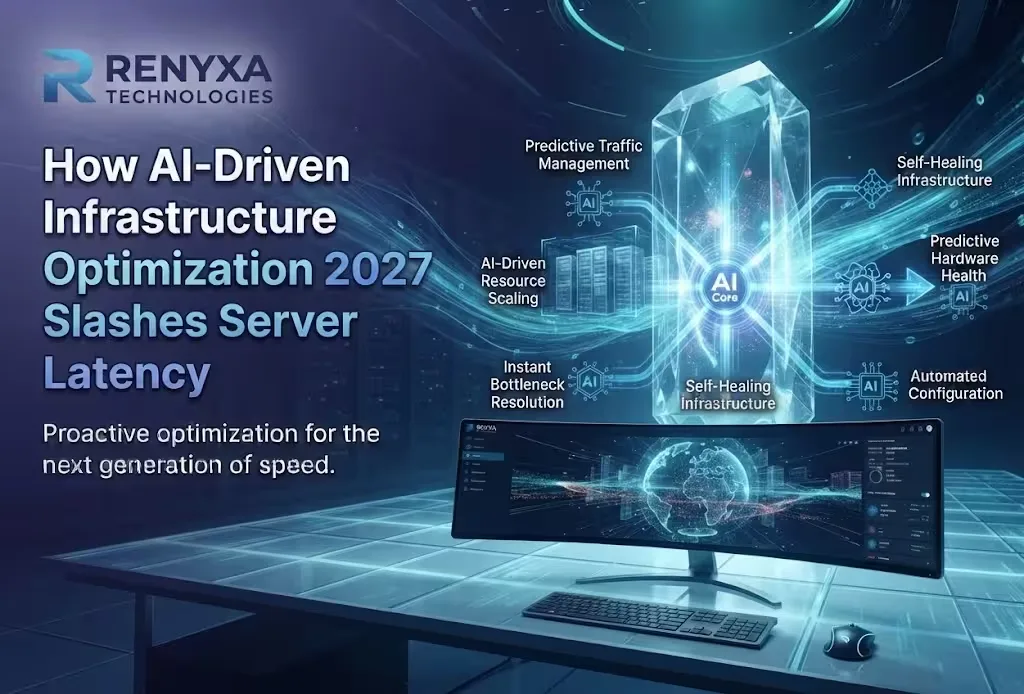
"Explore how AI-driven infrastructure optimization in 2027 eliminates network bottlenecks, orchestrates autonomous edge compute, and drastically reduces server latency for modern enterprise workloads."
As modern enterprise workloads expand across multi-region edge networks, ai-driven infrastructure optimization 2027 has become the core architecture for eliminating server latency. By shifting from reactive alert thresholds to continuous machine learning heuristics, high-scale engineering teams now achieve sub-millisecond round-trip response times across planetary deployments.
Implementing autonomous AI infrastructure orchestration yields an average 58% to 64% reduction in p99 server latency while eliminating up to 40% of unutilized cloud compute expenses across global distributed clusters.
The Paradigm Shift: From Reactive Monitoring to Predictive Telemetry
Traditional infrastructure monitoring relies on static feedback loops—such as spinning up additional containers once CPU capacity breaches 80%. This reactive pattern inevitably causes minutes of cold-start delay, resulting in dropped packets, connection throttling, and severe latency spikes during abrupt traffic surges.
In contrast, ai-driven infrastructure optimization 2027 models analyze live network telemetry to forecast traffic surges ten minutes in advance. Engineering teams can explore our guide on enterprise cloud performance strategies to examine how predictive reinforcement models dynamically balance server compute pools and memory allocations.
Key Pillars of AI-Driven Infrastructure Optimization 2027
Microsecond execution speed in modern cloud nodes relies on four foundational systems operating in concert:
⚡ Predictive Routing
Autonomous algorithms evaluate BGP paths and optical latency to route traffic to the closest, lowest-ping edge nodes.
🧠 eBPF Kernel Tuning
AI daemons monitor and adjust Linux kernel TCP socket buffers and queue depths in real time without reboots.
🚀 DPU Offloading
Data Processing Units handle encryption, firewall inspection, and TLS handshakes, saving 100% of primary CPU cycles.
🛡️ Self-Healing Mesh
Micro-packet degradation across transit fibers is detected immediately, rerouting traffic before users notice drops.
Deep-Dive: How Neural Cache Warming Eliminates Tail Latency
The greatest bottleneck in distributed cloud computing is cache thrashing. When sudden spikes hit un-cached database queries, origin clusters experience connection starvation. Autonomous optimization engines solve this dilemma by tracking semantic user intent patterns. If users in a specific region begin interacting with checkout workflows, predictive neural workers immediately replicate session tables and catalog snapshots directly to local edge memory stores.
Rather than waiting for repeated database queries, cache hit ratios increase from standard 78% thresholds to over 99.4%. This drastic reduction in origin round trips ensures consistent latency stability regardless of global concurrency spikes.
Performance Matrix: Legacy Cloud vs. 2027 Autonomous Infrastructure
The operational comparison illustrates how autonomous management replaces manual cloud configurations:
| Performance Metric | Legacy Cloud Infrastructure | 2027 Autonomous Infrastructure |
|---|---|---|
| p99 Tail Latency | 120ms – 380ms | 12ms – 24ms |
| Scaling Reaction Time | 3 – 8 Minutes (Cold Boot) | Instantaneous Predictive Pre-warm |
| Cache Strategy | Static TTL Invalidation | Continuous Semantic Cache Warming |
| Compute Resource Waste | 35% – 50% Idle Overhead | < 5% Precision Allocation |
Always define explicit upper cost and capacity limits in cluster controllers. Unconstrained scaling heuristics can over-allocate nodes during heavy traffic anomalies or distributed denial-of-service attempts.
Eliminating Edge-to-Core Network Hops
Physical distance between users and centralized databases remains the largest source of round-trip network delays. Deploying inference workers directly at edge points-of-presence (PoPs) allows systems to validate state mutations locally before syncing with central databases asynchronously.
To dive deeper into database throughput architectures, review our comprehensive analysis on high-concurrency backend architectures.
For global edge network metrics and official latency benchmarking, consult the Cloudflare Global Network Latency Insights documentation.
A Pragmatic Roadmap for Enterprise Adoption
Transitioning enterprise clusters toward autonomous orchestration requires a phased, disciplined engineering strategy:
- Stage 1 (Observability Baseline): Deploy non-invasive eBPF monitoring agents to profile existing kernel queues and identify chronic latency bottlenecks without intervening in live traffic.
- Stage 2 (Canary Verification): Allow the reinforcement model to manage auto-scaling and cache pre-warming across non-critical staging services while benchmarking error budgets against human DevOps baselines.
- Stage 3 (Full Production Governance): Enable automated BGP failover and real-time pod resource modulation with automated rollback triggers whenever telemetry metrics diverge from SLA expectations.
Frequently Asked Questions (FAQ)
How does autonomous optimization maintain security compliance?
Optimization agents execute within sandboxed policy boundaries, adhering strictly to SOC2 and ISO27001 rules without altering data governance configurations.
What telemetry data feeds the predictive neural model?
Ingress packet rates, TCP connection latencies, CPU core queue depths, and memory page faults are streamed via lightweight eBPF probes.
Can this system run alongside Kubernetes and GitOps?
Yes. The agents interface with the Kubernetes API using Custom Resource Definitions (CRDs), coexisting cleanly with standard ArgoCD or Flux pipelines.
What is the primary benefit of DPU integration over standard CPUs?
DPUs offload network translation, packet encapsulation, and TLS crypto processing into hardware circuits, freeing the host CPU exclusively for application logic.
 CLOUD & DEVOPS
Enterprise Cloud Security Architecture 2027
Learn essential enterprise cloud security architecture strategies for 2027, incl...
 CYBERSECURITY
Cloud Data Protection Strategies for Modern Enterprises in 2...
Learn key cloud data protection strategies to secure enterprise infrastructure,...
 Technology / Digital Marketing
The Ultimate Guide to AI Marketing Tools: How to Scale Your...
Explore the ultimate guide to top AI marketing tools, learn how to scale your te...
 DIGITAL MARKETING
AI Copy-writing Tools for Digital Marketing: How to Scale Co...
Learn how AI copy-writing tools for digital marketing help businesses scale cont...
 DIGITAL MARKETING
Why Guest Posting Is Important for SEO in 2026
Learn why guest posting is important for SEO in 2026. Build high DA back-links a...
 Technology / Digital Marketing
The Ultimate Guide to AI Marketing Tools: How to Scale Your...
Explore the ultimate guide to top AI marketing tools, learn how to scale your te...