
Multi-Agent AI Systems in Enterprise 2027
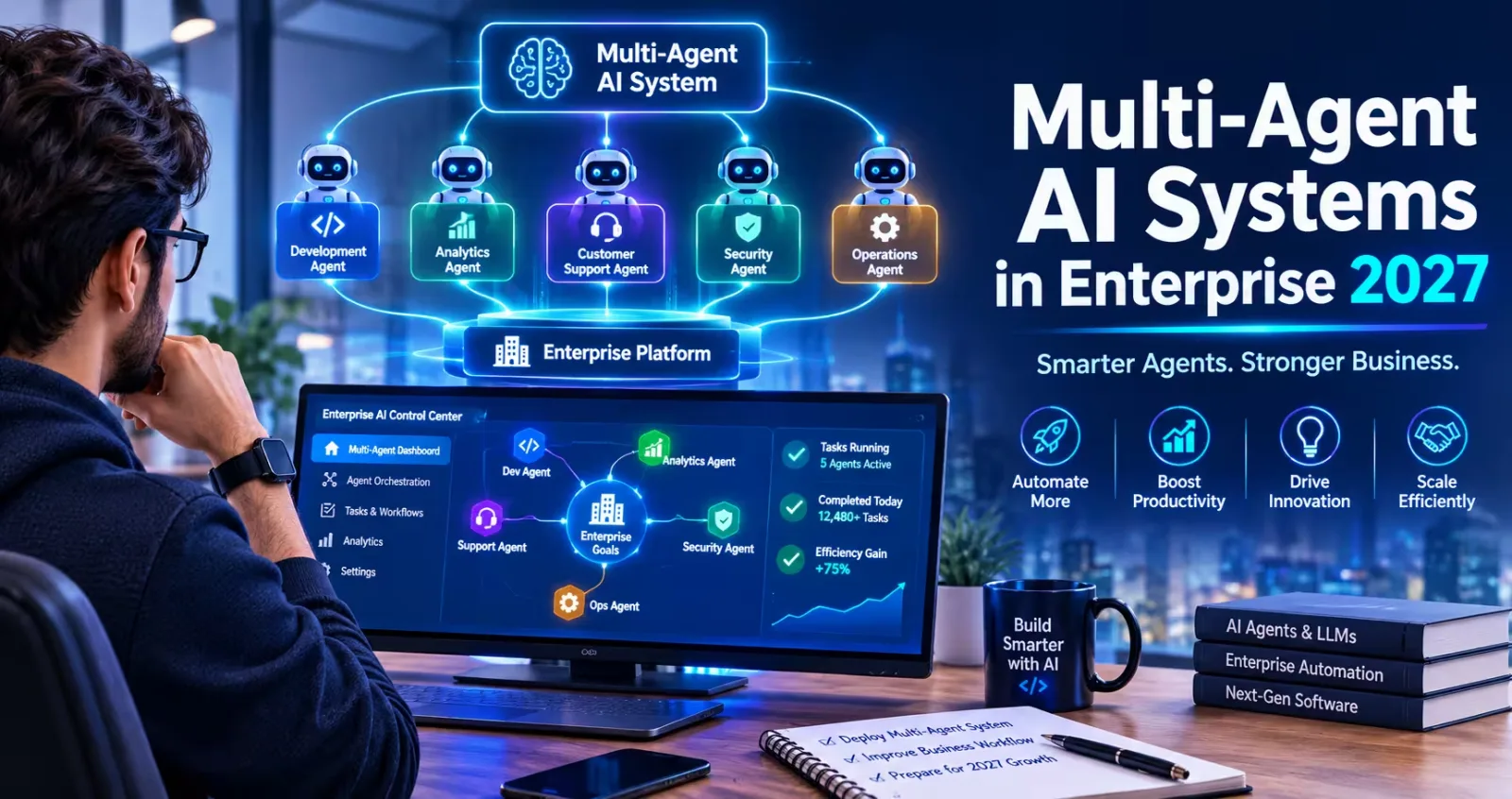
"Discover why multi-agent AI systems in enterprise 2027 are replacing monolithic LLM prompts. Learn how leading engineering teams architect autonomous collaborative agent swarms, manage memory fabrics, enforce deterministic guardrails, and achieve enterprise-grade scale."
As we advance toward 2027, the enterprise artificial intelligence landscape is undergoing its most consequential architectural paradigm shift since the emergence of transformer models. The era of relying on monolithic, single-prompt Large Language Models (LLMs) to execute complex corporate workflows is coming to a definitive end. Instead, forward-looking engineering teams are deploying multi-agent ai systems—federated networks of specialized, autonomous agents that collaborate, critique, negotiate, and execute mission-critical business processes with unprecedented deterministic reliability.
In this architectural deep dive, we examine the technical mechanics driving modern multi-agent systems, evaluate real-world enterprise deployments, explore core coordination patterns, and provide an actionable blueprint for engineering leaders aiming to transition from exploratory AI pilots to resilient, production-grade agentic swarms.
1. Why Monolithic Prompts Fail at Enterprise Scale
During the early generative AI wave, enterprises attempted to solve multi-faceted challenges by packing thousands of tokens of instructions, database schemas, and edge-case rules into a single context window. While effective for simple summarization or query generation, this approach collapses under the rigorous demands of enterprise software for several foundational reasons:
- Attention Degradation & Needle-in-a-Haystack Limits: Even models boasting million-token context windows suffer from attention degradation in the middle of long prompts. Complex instructions frequently get deprioritized or ignored during dense inference passes.
- High Blast Radius: If a single monolithic prompt fails midway through a 15-step transaction, the entire computation is lost. There is no isolated state inspection or targeted rollback mechanism.
- Context Pollution: Mixing financial reconciliation logic, API calling formatting, security policies, and user conversational tone in one context degrades the model's probabilistic reasoning.
- Prohibitive Cost & Latency: Reprocessing massive system instructions on every turn consumes unsustainable token volumes and introduces 3 to 8-second latencies unsuitable for real-time applications.
By decomposing monolithic logic into modular, specialized multi-agent ai systems, organizations establish discrete execution boundaries where each agent maintains an isolated context window, utilizes role-specific tools, and operates within deterministic validation rules.
2. Architectural Patterns for Multi-Agent AI Systems
Designing enterprise-ready multi-agent topologies requires moving beyond simple sequential chains (e.g., Agent A → Agent B → Agent C). In high-throughput corporate ecosystems, three primary orchestration patterns have emerged as the industry standard:
A. Hierarchical Orchestrator-Worker Topology
In this model, a supervisory meta-agent receives high-level enterprise goals (e.g., "Analyze quarterly churn risk across 4,000 mid-market accounts and trigger tailored retention plays"). The supervisor evaluates available capabilities, generates a dynamic Directed Acyclic Graph (DAG) of subtasks, and assigns tasks to specialized subordinate agents (e.g., Data Ingestion Agent, Anomaly Detection Agent, CRM Integration Agent). Once subordinates finish execution, an Auditor Agent evaluates output veracity before committing state changes.
B. Peer-to-Peer Consensus & Critic Networks
For high-risk domains such as algorithmic compliance, medical diagnostics, or code generation, multi-agent ai systems employ adversarial debate topologies. A Generator Agent produces an artifact (such as an automated cloud infrastructure Terraform script), a Security Critic Agent scans for vulnerabilities and compliance deviations, and a Performance Optimizer Agent validates cost ceilings. The agents converse across structured JSON schemas until a mathematical consensus threshold is reached.
C. Event-Driven Agentic Mesh
Rather than synchronous REST orchestration, cutting-edge organizations connect autonomous agents across event backbones like Apache Kafka, RabbitMQ, or NATS. Agents subscribe to business event topics, consume incoming payloads, execute asynchronous reasoning, and publish resulting state events. This decouples agent lifecycle management and enables horizontal elastic scaling.
3. Technology Matrix: Monolithic vs. Multi-Agent AI Systems in 2027
Understanding the infrastructural trade-offs is essential before committing capital to enterprise agentic migrations. The table below outlines key dimensions comparing traditional single-model setups against contemporary multi-agent fabrics:
| Architectural Dimension | Legacy Monolithic AI (2023–2024) | Modern Multi-Agent AI Systems (2027) |
|---|---|---|
| Reasoning Topology | Single prompt with bloated system context | Distributed, modular agent swarms with discrete roles |
| Hallucination Rate | High (12% – 18% in multi-step enterprise workflows) | Ultra-Low (< 0.8% via dual-agent verification & critics) |
| State & Memory Isolation | Shared global context with high memory leakage | Decoupled episodic vector memory + deterministic graph stores |
| Tool Execution Safety | Unchecked function calling with direct DB access | Least-privilege RBAC, ephemeral sandbox runtime, dry-run approvals |
| Fault Tolerance | Total pipeline abort upon single subtask exception | Granular agent retry, consensus fallback, and self-healing DAGs |
| Inference Efficiency | Expensive frontier model called for every token | SLMs (Small Language Models) for routing; Frontier LLMs for critical reasoning |
4. Security, Governance, and Human-in-the-Loop (HITL)
Deploying autonomous agents into production without robust governance guarantees is an unacceptable enterprise vulnerability. Production-grade multi-agent ai systems mandate three non-negotiable security layers:
1. Identity and Access Management for Agents (IAM-A)
Just as human employees operate under granular Role-Based Access Controls, autonomous agents must possess individual cryptographically signed identities (OAuth2 / SPIFFE tokens). A research agent should only possess read access to semantic document vectors, while an execution agent capable of initiating banking transfers requires short-lived, dual-key authorizations.
2. Deterministic Guardrail Proxies
Semantic guardrails must sit between inter-agent communication channels. Incoming and outgoing payloads pass through high-speed validation engines (such as NeMo Guardrails or custom Rust-based regex and PII filters) to prevent prompt injection propagation, data exfiltration, or infinite recursive loops.
3. Dynamic Human-in-the-Loop Escalation
Not every operation can or should be 100% automated. Resilient systems define strict confidence scoring thresholds. If an agent swarm's consensus certainty drops below 95% on a high-value financial transaction or customer agreement, the workflow automatically suspends execution and routes an interactive approval card to a human operator via Slack, Microsoft Teams, or an internal admin dashboard.
5. High-Impact Enterprise Deployments
Leading enterprises across diverse verticals are already reaping measurable financial returns by adopting multi-agent orchestration:
- Automated Software Engineering & QA: Development swarms consisting of an Architect Agent, Coding Agent, Security Auditor, and Unit Tester collaborate to resolve GitHub issues, generate pull requests, and verify test suites with minimal human intervention.
- Supply Chain Logistics & Dynamic Procurement: Sensor-monitoring agents detect shipment delays, communicate with Vendor Negotiation Agents, evaluate alternative maritime routes, and execute purchase orders within pre-authorized budget limits.
- Enterprise Customer Success & Support: Triage agents evaluate ticket urgency, dispatch technical research agents to query internal codebases and knowledge graphs, and formulate verified solutions in seconds rather than hours.
6. Strategic Roadmap: Building Your Enterprise Agentic Fabric
Transitioning your organization from conversational chatbots to autonomous agentic architectures requires a structured, multi-phase engineering methodology:
- Identify High-Friction, Multi-Step Workflows: Select processes currently bottlenecked by manual cross-department handoffs (e.g., KYC onboarding, vendor compliance auditing, or multi-cloud infrastructure drift remediation).
- Define Agent Personas and Tool Boundaries: Establish explicit single-responsibility principles for each agent. Equip agents exclusively with the specific SDKs and API endpoints necessary for their domain.
- Implement Shared Memory & Semantic State: Deploy hybrid memory stores combining Redis for active session state, PostgreSQL for structured relational records, and Qdrant or Milvus for vector retrieval.
- Partner with Enterprise AI Architects: Building reliable agentic systems requires deep expertise across distributed systems, model alignment, and secure API gateways. Explore Renvyxa's Enterprise AI & Autonomous Agent Engineering Services to accelerate your deployment lifecycle.
7. Frequently Asked Questions (FAQ)
What is the primary difference between single-agent and multi-agent AI systems?
A single-agent system relies on one language model to process instructions, reason through problems, and call tools within a unified prompt. In contrast, multi-agent AI systems distribute complex responsibilities across a swarm of distinct, specialized agents—each operating with its own prompt, tool permissions, and memory context—collaborating toward an overarching objective with significantly higher accuracy and fault tolerance.
How do multi-agent AI systems prevent infinite loops and runaway costs?
Enterprise multi-agent architectures implement strict deterministic bounds, including maximum iteration caps, total token budgets per session, circuit breaker timeouts, and cycle-detection algorithms within the orchestration DAG. If an agent enters an unproductive retry loop, the supervisor terminates the branch and triggers an alert or human escalation.
Can multi-agent systems combine models from different AI providers?
Yes. A major advantage of multi-agent architectures is model heterogeneity. Engineering teams frequently deploy cost-efficient, lightweight open-source models (such as Llama 3 or Mistral) for fast routing and summarization, while reserving frontier models (such as Claude 3.5 Sonnet, GPT-4o, or Gemini 1.5 Pro) for high-complexity coding and critical compliance analysis.
Explore more insights and architectural guides in the Renvyxa Engineering Knowledge Hub, or connect with our principal AI architects to design custom autonomous agent solutions for your enterprise.
 ARTIFICIAL INTELLIGENCE
AI SEO Automation: How to Scale Organic Traffic Without Losi...
Discover how enterprise engineering teams can scale organic search traffic using...
 CYBERSECURITY
Cloud Data Protection Strategies for Modern Enterprises in 2...
Learn key cloud data protection strategies to secure enterprise infrastructure,...
 Technology / Digital Marketing
The Ultimate Guide to AI Marketing Tools: How to Scale Your...
Explore the ultimate guide to top AI marketing tools, learn how to scale your te...
 DIGITAL MARKETING
AI Copy-writing Tools for Digital Marketing: How to Scale Co...
Learn how AI copy-writing tools for digital marketing help businesses scale cont...
 DIGITAL MARKETING
Why Guest Posting Is Important for SEO in 2026
Learn why guest posting is important for SEO in 2026. Build high DA back-links a...
 Technology / Digital Marketing
The Ultimate Guide to AI Marketing Tools: How to Scale Your...
Explore the ultimate guide to top AI marketing tools, learn how to scale your te...