
AI SEO Automation: How to Scale Organic Traffic Without Losing Quality in 2026

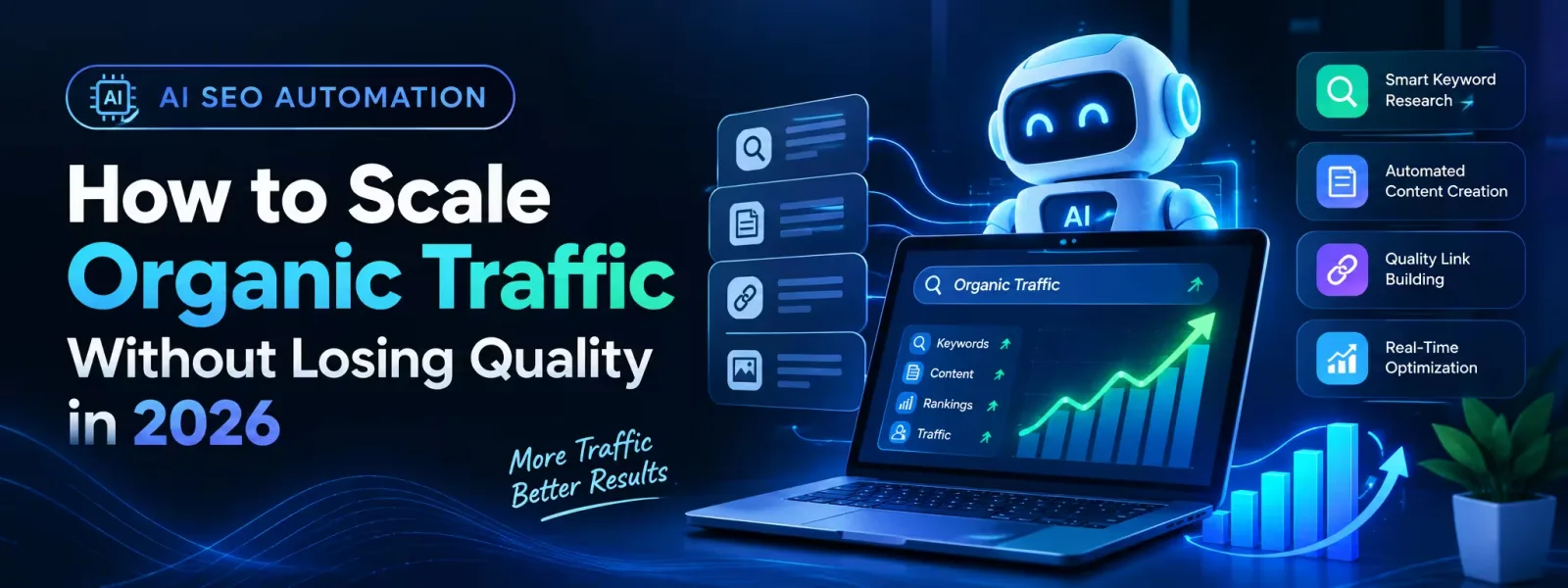
"Discover how enterprise engineering teams can scale organic search traffic using advanced RAG pipelines, multi-agent critique loops, and strict AI quality guardrails in 2026."
AI SEO Automation: How to Scale Organic Traffic Without Losing Quality in 2026
AI SEO automation is transforming how enterprises research, create, optimize, and manage content at scale. In 2026, businesses need more than keyword-focused articles and automated publishing tools to compete in organic search. They need intelligent systems that combine AI-driven efficiency with factual accuracy, topical relevance, and human expertise.
Search engines increasingly reward original, helpful, and trustworthy content. AI-generated content is not inherently a problem, but producing large volumes of pages without meaningful user value can create significant SEO risks.
For enterprise organizations, the challenge is clear: How can you scale organic traffic without sacrificing content quality, technical accuracy, or brand credibility?
The answer lies in building a controlled Automated content pipeline powered by Large Language Models (LLMs), Retrieval-Augmented Generation (RAG), semantic search, automated technical SEO, and structured quality assurance.
At Renvyxa Intelligent Systems, our approach focuses on designing intelligent automation architectures that connect enterprise data, AI capabilities, and business workflows.
Key Executive Takeaways
AI SEO automation should improve content quality and operational efficiency rather than simply increase publishing volume.
Enterprise RAG pipelines help ground AI-generated content in verified knowledge sources and reduce factual inaccuracies.
Automated keyword clustering, content optimization, and internal linking can improve consistency across large websites.
Multi-agent quality review and human oversight are essential for maintaining accuracy and brand standards.
SEO performance should be evaluated through organic engagement, qualified conversions, indexing performance, and measurable business outcomes.
1. Why AI SEO Automation Matters in 2026
Search behavior continues to evolve as traditional search engines incorporate conversational interfaces, AI-generated summaries, and more sophisticated information retrieval systems.
For enterprises, these developments create opportunities and challenges.
Traditional SEO methods such as keyword research, technical optimization, and internal linking remain important. However, manually managing every stage of a growing content operation can become expensive and difficult to maintain.
AI SEO automation addresses these challenges by connecting repetitive SEO activities into coordinated workflows.
The limitations of traditional content automation
Basic automation tools often rely on fixed templates or isolated prompts to generate content.
Without reliable knowledge sources and validation, these approaches can produce:
Repetitive articles with limited original insight.
Incorrect technical explanations or outdated statistics.
Duplicate or overlapping content targeting similar search intent.
Weak internal linking and inconsistent metadata.
Content that does not adequately answer the user's question.
Publishing more pages does not guarantee improved organic visibility.
Successful AI SEO automation focuses on publishing useful content that provides clear, relevant answers to real search queries.
Moving beyond keyword-focused optimization
Modern content strategies should consider the entities, concepts, and relationships surrounding a topic rather than relying only on exact keyword repetition.
For example, an article targeting AI SEO automation may naturally discuss:
Semantic keyword clustering.
Enterprise content workflows.
Retrieval-Augmented Generation.
Technical SEO automation.
AI content quality assurance.
Organic traffic analytics.
Search intent optimization.
These related concepts help build a comprehensive explanation that serves users more effectively.
2. Building an Enterprise AI SEO Automation Pipeline
An enterprise-grade Intelligent SEO system should operate as a structured workflow rather than a single content-generation script.
The architecture should separate research, content production, verification, publishing, and performance monitoring.
Step 1: Automated keyword research and intent mapping
Keyword research provides the foundation for scalable organic content planning.
AI-powered systems can consolidate data from Google Search Console, analytics platforms, approved keyword research tools, and enterprise search databases.
Machine learning and embedding models can then group search queries according to semantic similarity and potential search intent.
A typical process includes:
Collect search queries, impressions, clicks, and landing-page performance data.
Normalize duplicate or closely related queries.
Generate semantic embeddings for topic analysis.
Group related queries into content clusters.
Identify existing content gaps and competing pages.
Prioritize topics using business relevance and search opportunity.
The resulting topic map helps content teams avoid unnecessary duplication while identifying subjects that deserve deeper coverage.
Step 2: Grounded content generation using RAG
Retrieval-Augmented Generation is an important component of reliable enterprise AI SEO automation.
Instead of relying exclusively on general LLM knowledge, a RAG workflow retrieves relevant information from approved knowledge sources before generating content.
These sources may include:
Verified product documentation.
Enterprise knowledge bases.
Expert interviews and approved research.
Internal technical documentation.
Updated service information.
Authorized industry datasets.
The content-generation process uses the retrieved information to build more contextually accurate drafts.
However, RAG does not guarantee factual correctness. Retrieval failures, outdated documents, and unsupported conclusions can still occur.
For this reason, strong AI SEO automation systems require source traceability, evidence checking, and appropriate human review.
Step 3: AI-assisted content structuring
Once research has been validated, the content engine creates a structured article draft.
A well-designed system should consider:
Search intent and target audience.
Primary and related keywords.
Clear H1, H2, and H3 hierarchy.
Original examples and expert insights.
Readability and technical depth.
Contextual internal linking.
Relevant images and descriptive ALT text.
The goal is not to insert keywords into every paragraph. It is to deliver comprehensive content that answers the reader's question naturally.
3. AI SEO Automation Quality Control: The Multi-Agent Review Process
Content quality becomes increasingly important as publishing volume increases.
A mature AI SEO automation architecture separates content creation from evaluation.
Enterprise teams can also explore AI-powered workflow automation platforms like FlowForma, which help organizations streamline business processes, manage approvals, and maintain governance through intelligent automation.
Instead of publishing an initial LLM response immediately, the system sends each draft through a series of independent review stages.
The Author Agent
The Author Agent creates the article outline and initial draft based on approved sources, topic requirements, and brand guidelines.
Its primary responsibility is to organize complex information into understandable content.
The Fact-Checking Agent
The Fact-Checking Agent examines technical statements, statistics, product information, and other factual claims.
It compares those statements against approved evidence and flags unsupported or conflicting information.
Important claims should still be reviewed by qualified subject-matter experts where necessary.
The SEO and Readability Agent
The SEO Agent evaluates whether the draft addresses its intended search query.
Its checks may include:
Focus keyword placement.
Search intent alignment.
Heading structure.
Relevant topic coverage.
Internal linking opportunities.
Metadata accuracy.
Readability and unnecessary repetition.
These checks support content improvement but cannot independently predict Google rankings.
The Brand and Compliance Agent
The Compliance Agent checks content against approved editorial and business rules.
This may include brand terminology, prohibited claims, legal requirements, tone consistency, and industry-specific publishing standards.
Human-in-the-loop approval
Not every content decision should be fully automated.
High-impact articles, complex technical explanations, regulated topics, and material business claims should receive human approval before publication.
A practical workflow is:
Research → AI Draft → Fact Verification → SEO Review → Brand Review → Human Approval → Publication
This review process makes AI SEO automation more reliable while preserving the efficiency benefits of intelligent content production.
4. Technical SEO Automation for Enterprise Websites
Content quality alone cannot overcome major technical website problems.
Enterprise AI SEO automation must also support the underlying infrastructure responsible for content discovery, crawling, indexing, and navigation.
Automated metadata optimization
AI-powered workflows can generate draft SEO titles and meta descriptions using the page's actual subject matter.
These drafts should be validated for relevance, clarity, duplication, and brand consistency.
Performance data from Google Search Console can help teams identify opportunities to test more useful or compelling titles and descriptions.
However, improved click-through rates cannot be guaranteed, and metadata changes should be evaluated against actual search performance.
Structured data generation
Structured data helps search engines understand supported information about a webpage.
Automation systems can generate appropriate JSON-LD markup based on page type.
Examples include:
Article or BlogPosting.
Organization.
Product, where applicable.
BreadcrumbList.
Other supported structured data types relevant to the page.
All generated markup should be validated and must accurately reflect visible page content.
Intelligent internal linking
Internal links help users discover related information and support search engine navigation.
An AI-powered internal linking engine can analyze existing articles and identify relevant linking opportunities.
A practical implementation involves:
Indexing published website content.
Identifying relationships between pages.
Finding relevant contextual linking opportunities.
Suggesting descriptive anchor text.
Checking destination URLs and avoiding excessive linking.
Reviewing and publishing approved links.
This process helps reduce orphan pages and supports a more coherent website structure.
Automated technical monitoring
AI SEO automation can also support ongoing website quality checks.
Common monitoring tasks include broken link detection, missing metadata, canonical inconsistencies, indexing problems, XML sitemap validation, and unexpected changes in crawlability.
Automation should alert the responsible team when significant technical problems appear.
5. Measuring AI SEO Automation Performance and ROI
A successful enterprise SEO strategy must connect organic visibility with meaningful business outcomes.
Publishing hundreds of AI-assisted articles is not necessarily a sign of progress.
The important question is whether the published content attracts relevant users and contributes to sustainable business growth.
Key performance indicators
Organic Traffic Growth
Measure changes in organic sessions and search clicks over meaningful time periods while accounting for seasonality and search demand.
Keyword Visibility
Track relevant search queries, ranking trends, and impressions across strategically important topic clusters.
Indexing Performance
Monitor which submitted pages are indexed, which are excluded, and whether important pages remain accessible.
Content Engagement
Evaluate whether visitors interact with the content and find relevant information.
Qualified Conversions
Track organic enquiries, demo requests, consultation bookings, and other measurable business actions.
Content Production Efficiency
Compare the cost and time required to research, produce, verify, and maintain content before and after automation.
These metrics allow organizations to assess both SEO outcomes and operational improvements.
6. Managing SEO Risks in AI-Generated Content
AI-powered publishing introduces operational risks when organizations prioritize speed over reliability.
An enterprise automation strategy should address these risks from the beginning.
Avoid low-value content at scale
Google's guidance focuses on creating helpful, reliable, people-first content.
Using automation to generate large volumes of pages primarily to manipulate search rankings can violate Google's spam policies.
Organizations should prioritize content that adds original information, useful explanations, expert insight, or distinctive value.
Maintain source accuracy
Technical claims, statistics, and product information should be verified against trustworthy sources.
Content based on rapidly changing information also needs regular review and updating.
Protect enterprise data
Connecting AI models to internal documents requires appropriate access controls, secure retrieval processes, and careful handling of confidential information.a
Not every internal document should automatically become available to a content-generation system.
Implement continuous quality monitoring
After publication, organizations should monitor content performance and periodically review pages for outdated information, technical issues, and changing user needs.
AI SEO automation should support the entire content lifecycle, not simply article generation.
7. How Renvyxa Approaches Enterprise AI SEO Automation
At Renvyxa Intelligent Systems, we focus on intelligent automation architectures designed around business requirements, technical reliability, and scalable operations.
An enterprise AI SEO automation solution can combine several core capabilities:
AI-assisted keyword research and semantic topic clustering.
Secure RAG integrations with approved knowledge sources.
Automated content drafting and structured editorial workflows.
Fact-checking, compliance controls, and human approval.
Technical SEO monitoring and contextual internal linking.
Search performance analytics and continuous improvement.
The goal is to help organizations reduce repetitive work while maintaining control over published information.
Rather than treating AI as a replacement for experienced professionals, a well-designed system enables editorial, technical, and marketing teams to operate more efficiently.
Frequently Asked Questions About AI SEO Automation
What is AI SEO automation?
AI SEO automation uses artificial intelligence and software workflows to support tasks such as keyword research, content planning, drafting, optimization, internal linking, and performance monitoring.
Can AI SEO automation improve organic traffic?
It can support organic traffic growth by improving content workflows, identifying opportunities, and maintaining technical consistency. Results depend on content quality, competition, website health, search demand, and other factors.
Does Google penalize AI-generated content?
Google does not automatically penalize content simply because AI helped produce it. However, generating large amounts of low-value content to manipulate rankings can violate Google's spam policies.
How does RAG improve AI-generated SEO content?
Retrieval-Augmented Generation provides relevant source material to an AI model during generation. This can improve contextual accuracy and reduce unsupported claims, although verification remains necessary.
Should enterprises fully automate SEO content publishing?
Full automation may be appropriate for selected low-risk tasks, but important editorial, factual, and compliance decisions should include appropriate human oversight.
Conclusion: Scale Organic Growth Through Intelligent Automation
AI SEO automation in 2026 is not simply about generating content faster. It is about creating a reliable system that connects research, knowledge management, content production, technical optimization, and measurable business results.
Enterprises that combine LLMs, RAG, structured quality controls, and human expertise can build more efficient content operations without abandoning accuracy or credibility.
At Renvyxa Intelligent Systems, we help organizations explore intelligent automation solutions designed for complex enterprise requirements.
Ready to improve your enterprise SEO workflows? Contact Renvyxa to discuss an AI automation solution aligned with your business goals.
 ARTIFICIAL INTELLIGENCE
Multi-Agent AI Systems in Enterprise 2027
Discover why multi-agent AI systems in enterprise 2027 are replacing monolithic...
 CYBERSECURITY
Cloud Data Protection Strategies for Modern Enterprises in 2...
Learn key cloud data protection strategies to secure enterprise infrastructure,...
 Technology / Digital Marketing
The Ultimate Guide to AI Marketing Tools: How to Scale Your...
Explore the ultimate guide to top AI marketing tools, learn how to scale your te...
 DIGITAL MARKETING
AI Copy-writing Tools for Digital Marketing: How to Scale Co...
Learn how AI copy-writing tools for digital marketing help businesses scale cont...
 DIGITAL MARKETING
Why Guest Posting Is Important for SEO in 2026
Learn why guest posting is important for SEO in 2026. Build high DA back-links a...
 Technology / Digital Marketing
The Ultimate Guide to AI Marketing Tools: How to Scale Your...
Explore the ultimate guide to top AI marketing tools, learn how to scale your te...