
Cloud Infrastructure Cost Optimization Strategies
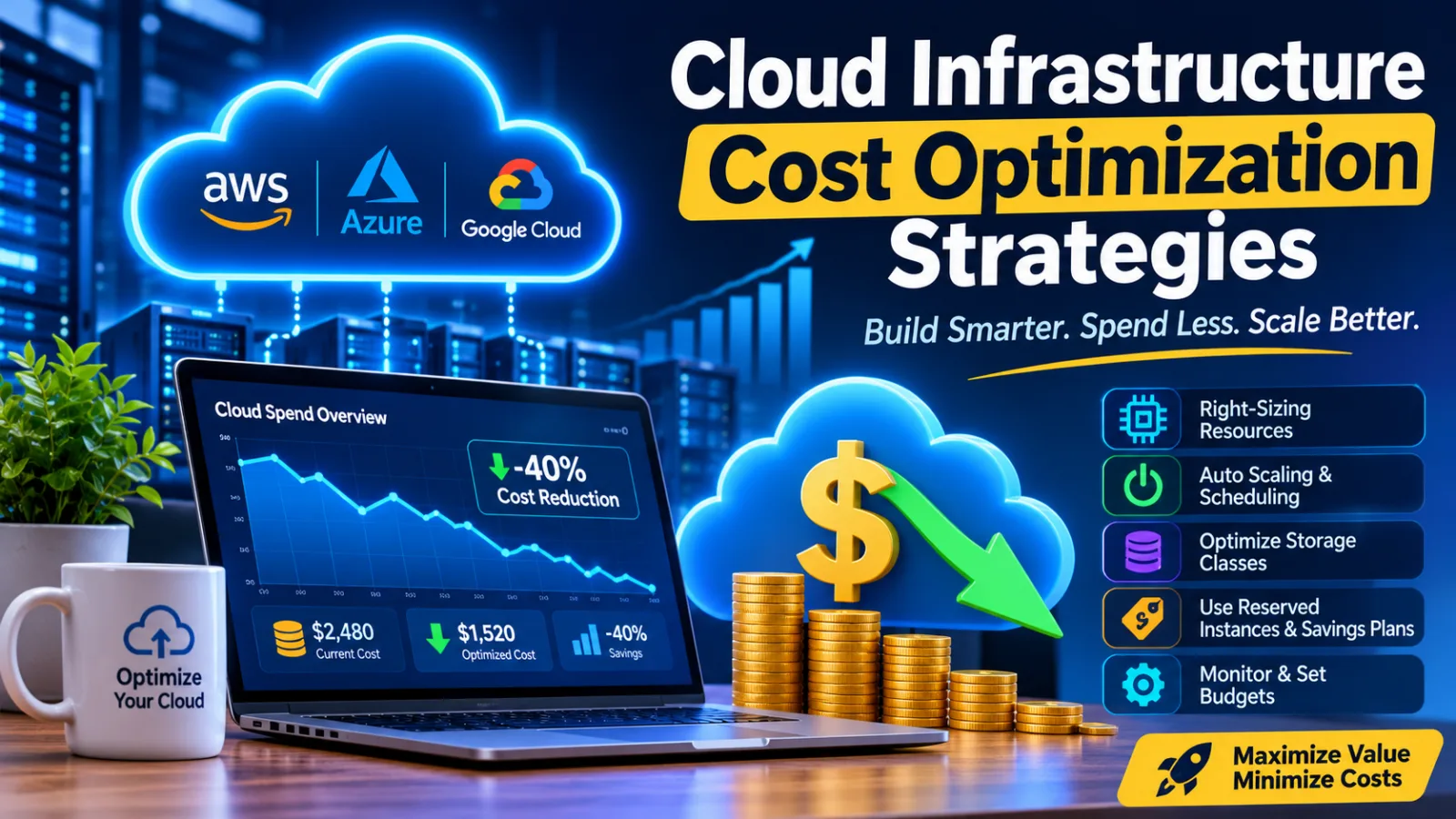
"Discover actionable cloud infrastructure cost optimization strategies to slash AWS, Azure, and Google Cloud expenses by 30% to 50%. Learn proven FinOps frameworks, intelligent Kubernetes rightsizing, architectural commitments, and automated resource hygiene for high-growth enterprises."
In modern enterprise engineering, cloud computing expenses represent one of the fastest-growing line items on corporate balance sheets. As architectures scale across AWS, Microsoft Azure, and Google Cloud Platform (GCP), unchecked cloud waste, oversized compute instances, and unmonitored storage tiers routinely inflate monthly cloud bills by 35% to 50%. Mastering cloud infrastructure cost optimization is no longer just a financial hygiene exercise—it is a critical engineering discipline that directly impacts gross margins, infrastructure velocity, and competitive advantage.
Whether your organization operates multi-tenant Kubernetes clusters, high-throughput microservices, or petabyte-scale data lakes, achieving sustainable cost efficiency requires combining cultural FinOps principles with automated architectural engineering. In this comprehensive guide, we unpack battle-tested cloud infrastructure cost optimization strategies to eliminate cloud waste without sacrificing performance, security, or system resilience.
1. The Anatomy of Enterprise Cloud Waste: Where Does the Money Go?
Before implementing remediation tactics, engineering leaders must identify the root causes of runaway expenditures. In production environments, cloud waste typically concentrates in four primary domains:
- Over-Provisioned Compute & Phantom Capacities: Developers routinely configure VM instances and Kubernetes pods for peak hypothetical loads that only occur 1% of the year. Instances idling at 5% to 10% CPU utilization drain tens of thousands of dollars each month.
- Orphaned Volumes and Unattached Storage: When virtual machines or container clusters are decommissioned, attached persistent disks (AWS EBS, Azure Managed Disks), unattached Elastic IPs, and obsolete snapshots often remain active, quietly accumulating storage billing.
- Data Egress and Inter-Region Bandwidth Traps: Cloud providers offer generous inbound data transfer, but cross-AZ (Availability Zone), cross-region, and internet egress charges can unexpectedly account for 15% to 25% of the total monthly invoice.
- Sub-Optimal Pricing Models: Relying exclusively on default On-Demand pricing for steady-state workloads is the single most expensive way to consume cloud infrastructure.
2. Architectural Pillars for Cloud Infrastructure Cost Optimization
Executing a sustainable reduction in infrastructure spend requires systematic intervention across the entire cloud lifecycle. Below are the essential pillars powering modern cloud infrastructure cost optimization:
A. Algorithmic Rightsizing of Compute and Memory
Rightsizing is the continuous process of analyzing operational resource metrics and adjusting instances to the smallest size and most cost-effective family that comfortably meets performance SLOs. Rather than manual guesswork, automated agents analyze 30-day P95 and P99 percentiles for CPU, RAM, and I/O:
- Upgrading to Latest-Generation Silicon: Migrating legacy x86 instances to ARM-based architectures (such as AWS Graviton3/4, GCP Tau T2A, or Azure Ampere Altra) delivers an immediate 20% to 40% price-to-performance gain with minimal recompilation.
- Dynamically Bursting Workloads: Non-production environments, staging pipelines, and background batch workers should leverage burstable instances (e.g., AWS t4g, Azure B-series) to minimize idle cycle costs.
B. Maximizing Savings with Strategic Commitments
For predictable, steady-state baselines, commitment discounts offer the largest immediate ROI:
- Compute Savings Plans & Reserved Instances (RIs): Committing to a consistent compute spend over a 1-year or 3-year term unlocks discounts ranging from 30% to 72% compared to On-Demand rates. A flexible Compute Savings Plan applies automatically across EC2, Fargate, and Lambda regardless of instance family, region, or operating system.
- Spot Instances for Fault-Tolerant Architectures: Utilizing excess provider capacity via Spot Instances (or Preemptible VMs) cuts compute costs by up to 90%. When combined with graceful termination handlers, Spot instances are ideal for stateless Kubernetes worker nodes, CI/CD runners, and asynchronous batch workers.
C. Kubernetes Cluster Efficiency & Bin-Packing Optimization
In modern microservices architectures, Kubernetes is frequently the single largest cloud expenditure. Achieving true cluster density requires three operational guardrails:
- Calibrating CPU & Memory Requests: If a pod requests 2 vCPUs but averages 150m, the scheduler reserves the full 2 vCPUs on the underlying node. Tuning requests to match real P95 utilization allows 3x to 5x more workloads to run on identical node pools.
- Deploying Karpenter for Just-in-Time Node Provisioning: Legacy cluster autoscalers scale node groups based on rigid instance templates. Advanced orchestrators like Karpenter evaluate pending pod requirements directly and launch the exact, cheapest mix of Spot and On-Demand instances in seconds.
- Enforcing Horizontal & Vertical Pod Autoscaling (HPA / VPA): Combining HPA with VPA (in recommendation mode) ensures containers scale dynamically with user traffic while rightsizing their base footprint.
3. Technology Matrix: Traditional Cloud Management vs. Modern FinOps
The matrix below contrasts legacy, reactive infrastructure maintenance against an automated cloud infrastructure cost optimization architecture:
| Operational Dimension | Legacy Reactive Management | Modern Cloud Infrastructure Cost Optimization |
|---|---|---|
| Cost Visibility | Monthly retroactive PDF invoice analysis | Real-time cost telemetry tagged to services and teams |
| Compute Provisioning | Static peak-load On-Demand sizing | Dynamic Spot/On-Demand mix with Graviton/ARM silicon |
| Kubernetes Scheduling | Manual node groups with rigid sizes | Karpenter just-in-time bin-packing with precise pod requests |
| Storage Lifecycle | Static standard SSD/S3 storage indefinitely | Automated tiering (Standard → Infrequent → Glacier Deep Archive) |
| Governance Guardrails | Ad-hoc spreadsheet audits and manual cleanup | Automated CI/CD pull request cost diffs (Infracost) & tagging policies |
| Average Cloud Waste | 35% – 50% of annual spend | < 8% across global infrastructure footprint |
4. Storage Tiering and Network Bandwidth Optimization
While compute dominates discussion, data lifecycle management and network topologies represent significant opportunities for cloud infrastructure cost optimization:
1. Intelligent Storage Lifecycle Automation
Unstructured data stored in Amazon S3, Azure Blob Storage, or Google Cloud Storage frequently cools down after 30 days. Implementing automated lifecycle policies transitions objects from high-performance tiers to Infrequent Access (IA), Archive, and Glacier Deep Archive, yielding an 80% to 95% reduction in per-gigabyte monthly cost.
2. Eliminating Cross-AZ and Egress Data Charges
Calling an internal service or database located in a different Availability Zone incurs inter-AZ networking fees ($0.01/GB in each direction). High-throughput distributed systems can slash networking expenses by:
- Co-locating Chatty Microservices: Utilizing Kubernetes Topology Aware Routing to keep internal service-to-service RPC calls within the same Availability Zone whenever possible.
- VPC Endpoints & PrivateLink: Accessing cloud services (such as S3, DynamoDB, or BigQuery) directly via gateway VPC endpoints rather than routing traffic across NAT Gateways and the public internet.
- Cloudflare & Global CDN Caching: Offloading static and dynamic cacheable traffic at the edge reduces primary origin egress bandwidth fees to nearly zero.
5. Embedding FinOps Culture & CI/CD Cost Guardrails
Sustainable cost optimization is fundamentally a culture of engineering accountability, codified through policy-as-code:
- Mandatory Resource Tagging Policies: Enforce strict AWS IAM or Azure Policy rules preventing resources from launching without required metadata tags: (prod, staging, dev), , , and .
- Pull Request Cost Estimations (Infracost): Integrate automated cost checks into GitHub Actions or GitLab CI. When a software engineer modifies Terraform, Pulumi, or CloudFormation templates, the pipeline comments directly on the pull request with projected monthly cost variances before merge.
- Automated Non-Production Scheduling: Development and QA environments rarely need to run overnight or over weekends. Cloud automation scripts that shut down non-production clusters at 7:00 PM and restart them at 7:00 AM immediately eliminate 65% of staging compute costs.
6. Strategic 90-Day Cloud Cost Optimization Roadmap
To capture immediate ROI while laying foundations for long-term cloud governance, execute this phased engineering plan:
- Days 1–30: The Hygiene Sprint (Instant 15%–25% Savings): Terminate orphaned EBS volumes, release unused Elastic IPs, enforce non-production shutdown schedules, and delete obsolete snapshots and unattached load balancers.
- Days 31–60: Compute & Storage Rightsizing: Analyze operational P95 telemetry, rightsize bloated VM and container footprints, migrate eligible workloads to ARM/Graviton, and configure S3/Blob Intelligent-Tiering.
- Days 61–90: Commitment Modeling & CI/CD Automation: Purchase flexible 1-year Savings Plans for steady-state workloads, implement Karpenter on Kubernetes, and deploy Infracost into pull request pipelines.
- Partner with Enterprise DevOps Architects: Complex multi-cloud migrations and automated FinOps architecture require seasoned systems engineering. Partner with the Renvyxa Cloud & DevOps Engineering Team to conduct an end-to-end infrastructure audit and lock in sustainable savings.
7. Frequently Asked Questions (FAQ)
What is the fastest way to achieve cloud infrastructure cost optimization?The quickest win is eliminating orphaned resources (unattached persistent disks, idle load balancers, old snapshots), scheduling non-production environments to sleep during off-hours, and activating storage lifecycle rules. These immediate hygiene measures routinely shave 15% to 25% off monthly invoices within the first week with zero production risk.
How does FinOps differ from traditional IT procurement?Traditional procurement negotiates fixed hardware contracts retroactively once a year. In contrast, FinOps is an ongoing operational discipline that unites engineering, finance, and product teams. It gives software engineers real-time visibility into the cost impact of their architectural decisions and encourages proactive rightsizing directly within the development workflow.
Is it safe to use Spot Instances for production enterprise workloads?Yes, provided the workloads are stateless, horizontally scalable, and decoupled from state. By combining Spot Instances with modern Kubernetes controllers like Karpenter or AWS Node Termination Handler, nodes automatically drain and reschedule pods onto On-Demand fallback instances when receiving a 2-minute interruption notice, achieving up to 90% savings without downtime.
Discover more enterprise DevOps architectural frameworks in the Renvyxa Engineering Knowledge Hub, or schedule a comprehensive Cloud FinOps Consultation with our principal cloud architects.
 AI & Innovation
Top Open Source AI Tools You Should Try in 2026
Discover the top open source AI tools of 2026. Explore powerful, privacy-focused...
 ARTIFICIAL INTELLIGENCE
Cost to Build an Enterprise AI Agent in 2026: Pricing Breakd...
What is the real cost to build an enterprise AI agent in 2026? From MVP proof-of...
 ARTIFICIAL INTELLIGENCE
Multi-Agent AI Systems in Enterprise 2027
Discover why multi-agent AI systems in enterprise 2027 are replacing monolithic...
 ARTIFICIAL INTELLIGENCE
AI SEO Automation: How to Scale Organic Traffic Without Losi...
Discover how enterprise engineering teams can scale organic search traffic using...
 CYBERSECURITY
Cloud Data Protection Strategies for Modern Enterprises in 2...
Learn key cloud data protection strategies to secure enterprise infrastructure,...
 Technology / Digital Marketing
The Ultimate Guide to AI Marketing Tools: How to Scale Your...
Explore the ultimate guide to top AI marketing tools, learn how to scale your te...
 DIGITAL MARKETING
AI Copy-writing Tools for Digital Marketing: How to Scale Co...
Learn how AI copy-writing tools for digital marketing help businesses scale cont...
 DIGITAL MARKETING
Why Guest Posting Is Important for SEO in 2026
Learn why guest posting is important for SEO in 2026. Build high DA back-links a...